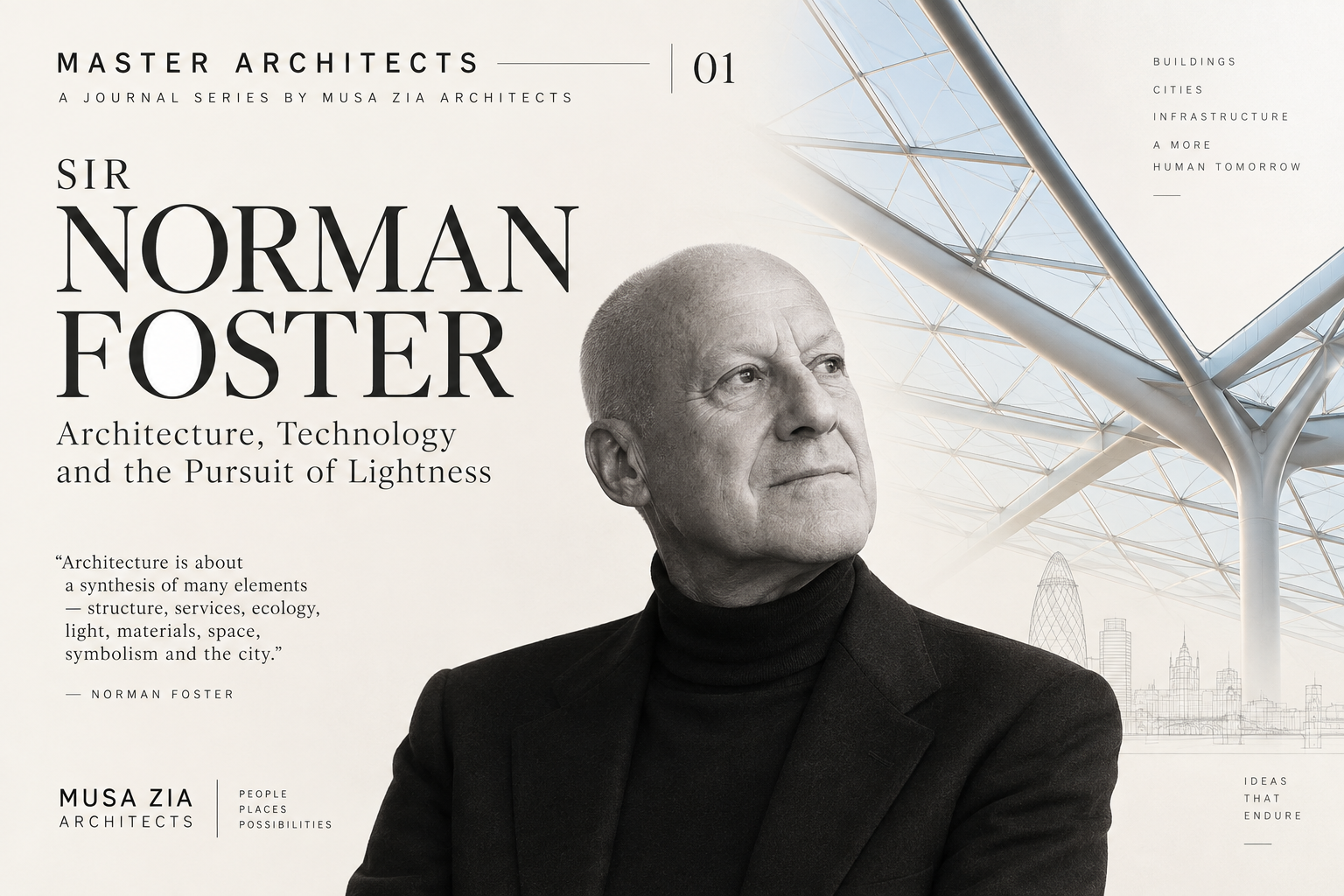
There are architects whose buildings belong to a particular period, and there are architects whose work helps define that period. Sir Norman Foster belongs firmly to the second category.
For more than half a century, Foster has explored a fundamental architectural question: how can technology, structure, light, environment and human experience be brought together so completely that they cease to appear as separate disciplines?
His architecture is unmistakably modern, yet reducing Foster simply to the label of “high-tech architect” misses much of what makes his work important. Behind the steel, glass, exposed structures and extraordinary engineering is a persistent search for clarity: clarity of movement, structure, function and idea.
From the HSBC headquarters in Hong Kong to the Reichstag in Berlin, from Stansted Airport to 30 St Mary Axe and the Millau Viaduct, Foster has repeatedly demonstrated that engineering does not have to be hidden behind architecture.
It can become architecture.
From Manchester to the World
Norman Foster was born in Manchester, England, in 1935 into a working-class family. His path into architecture was therefore very different from the privileged professional route associated with many architects of earlier generations.
After completing national service in the Royal Air Force, Foster studied architecture and city planning at the University of Manchester, graduating in 1961. A Henry Fellowship subsequently took him to Yale University, where he received a master’s degree in architecture.
The international exposure proved important.
The optimism of post-war modernism, technological experimentation and the work of figures such as Buckminster Fuller would become significant influences on Foster’s developing architectural thinking.
After the collaborative period of Team 4, Foster established the practice that would eventually become Foster + Partners in 1967.
What began as a relatively small experimental studio ultimately developed into one of the world’s most influential architectural practices.
In 1983 Foster received the RIBA Royal Gold Medal. He was knighted in 1990 and received the Pritzker Architecture Prize in 1999.
Yet the awards tell us considerably less about Foster than the buildings themselves.
Architecture as an Integrated System
One of Foster’s greatest contributions is his refusal to think of architecture merely as composition.
A building is not simply a façade enclosing rooms.
It is a system.
Structure, circulation, mechanical services, daylight, energy, materials, landscape, movement and human occupation all participate in that system.
Foster has described architecture as a balancing act involving measurable requirements alongside the spiritual, intangible and subjective dimensions of building.
This idea explains much of his work.
Rather than designing an architectural form and subsequently asking engineers to make it possible, Foster’s best buildings appear to emerge from a dialogue between architecture and engineering from the very beginning.
The distinction is important.
Technology in Foster’s architecture is rarely intended merely as decoration. At its strongest, technological innovation produces the architecture itself.
Structure as Architecture
Traditional buildings often conceal their structural systems.
Foster frequently does the opposite.
Columns, trusses, masts, tension systems and structural connections are allowed to participate in the visual identity of the building.
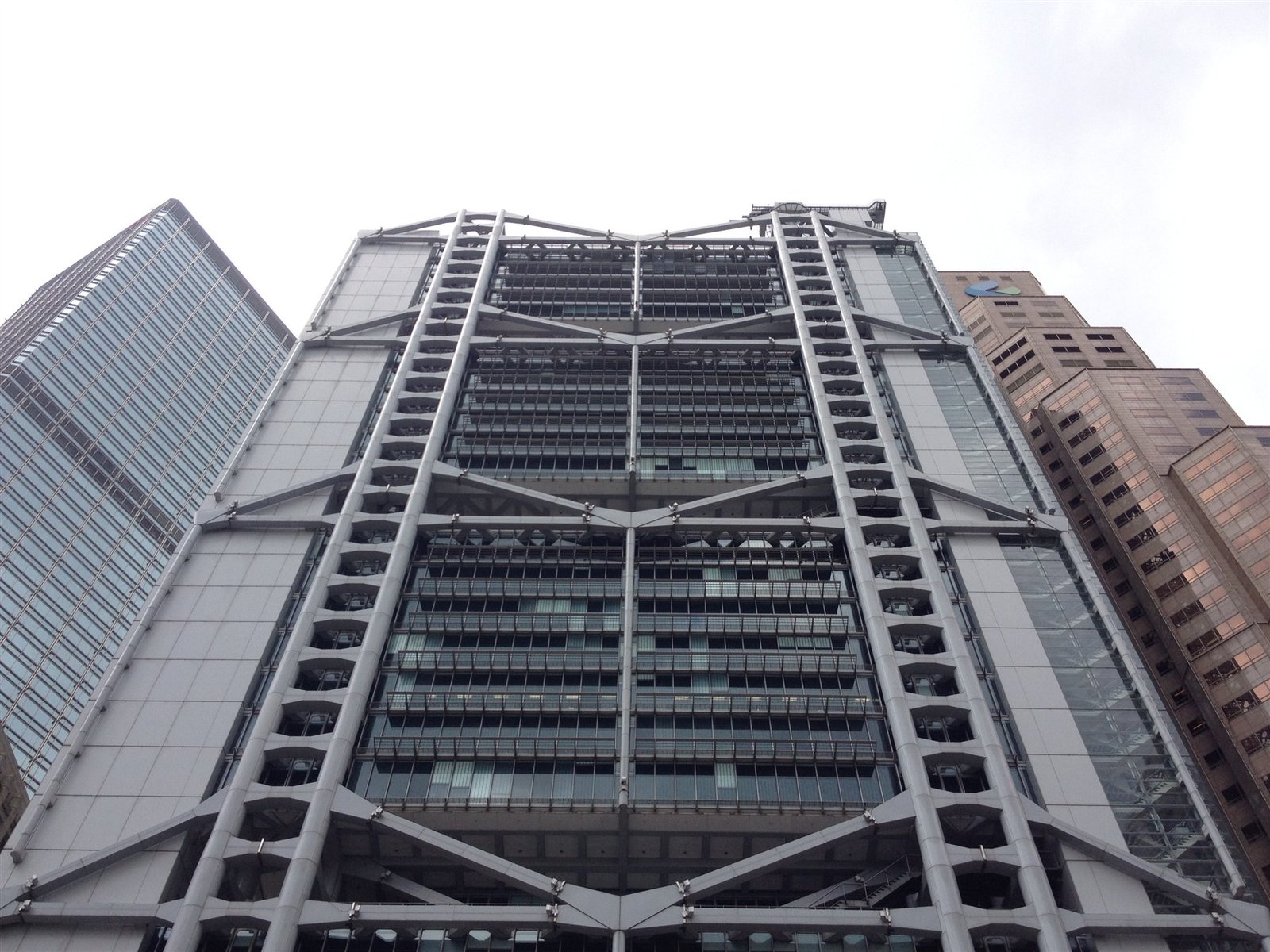
Few projects demonstrate this better than the Hongkong and Shanghai Bank Headquarters in Hong Kong.
The commission began in 1979 and offered Foster an unusual opportunity to reconsider the conventional office tower.
Rather than accepting the familiar formula of repetitive floors surrounding a central concrete core, the building’s structure and services were reorganised radically.
Large structural masts support suspended floor groups while services and circulation become clearly expressed components of the architecture.
The result is not simply an office building with an unusual appearance.
It is a reconsideration of what an office tower could be.
Innovation begins when the architect is prepared to question the typology itself.
Stansted Airport: Finding the Simple Idea
Airports are among the most complicated buildings architects can design.
Their complexity often produces confusing architecture: multiple levels, long corridors, artificial lighting, signage everywhere and passengers struggling to understand where they are supposed to go.
At Stansted Airport, Foster approached the problem differently.
Instead of accepting the airport terminal as an inherently complicated machine, he looked back toward the simplicity of early aviation, when passengers could intuitively understand the relationship between road, terminal and aircraft.
The solution was remarkably clear.
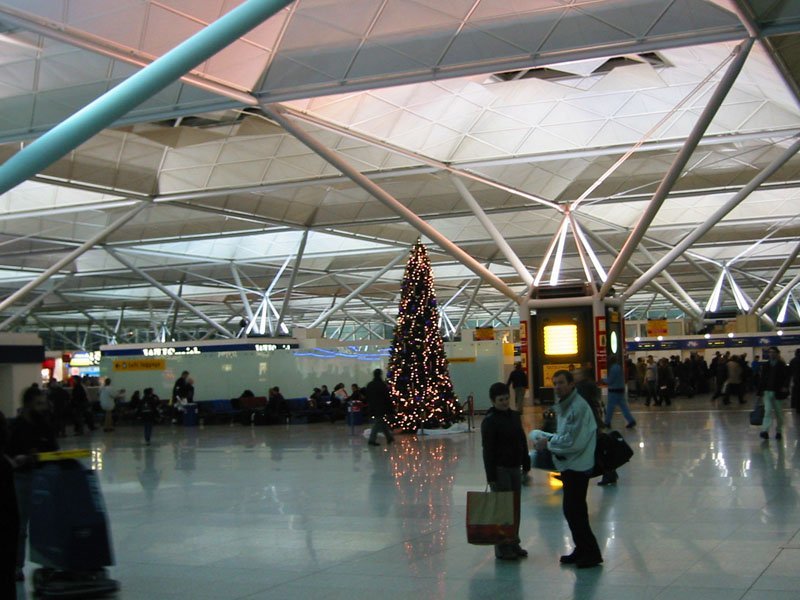
Much of the heavy infrastructure normally placed above passengers was moved beneath the main concourse. Structural “trees” carry services upward while supporting a lightweight roof.
The roof therefore performs its most fundamental architectural tasks: providing shelter while admitting daylight.
Passengers move through a largely open, naturally understandable space.
The brilliance of Stansted is therefore not technological complexity.
It is complexity organised so successfully that the user experiences simplicity.
This may be one of Foster’s most valuable lessons for architects.
A sophisticated building does not need to feel complicated.
The Reichstag: When Technology Becomes Symbolism
The transformation of Berlin’s Reichstag demonstrates another dimension of Foster’s architecture.
Here the architect was not working on an empty site.
He was intervening in a building carrying enormous historical and political significance.
Instead of attempting to erase history, Foster allowed old and new architecture to remain legible.
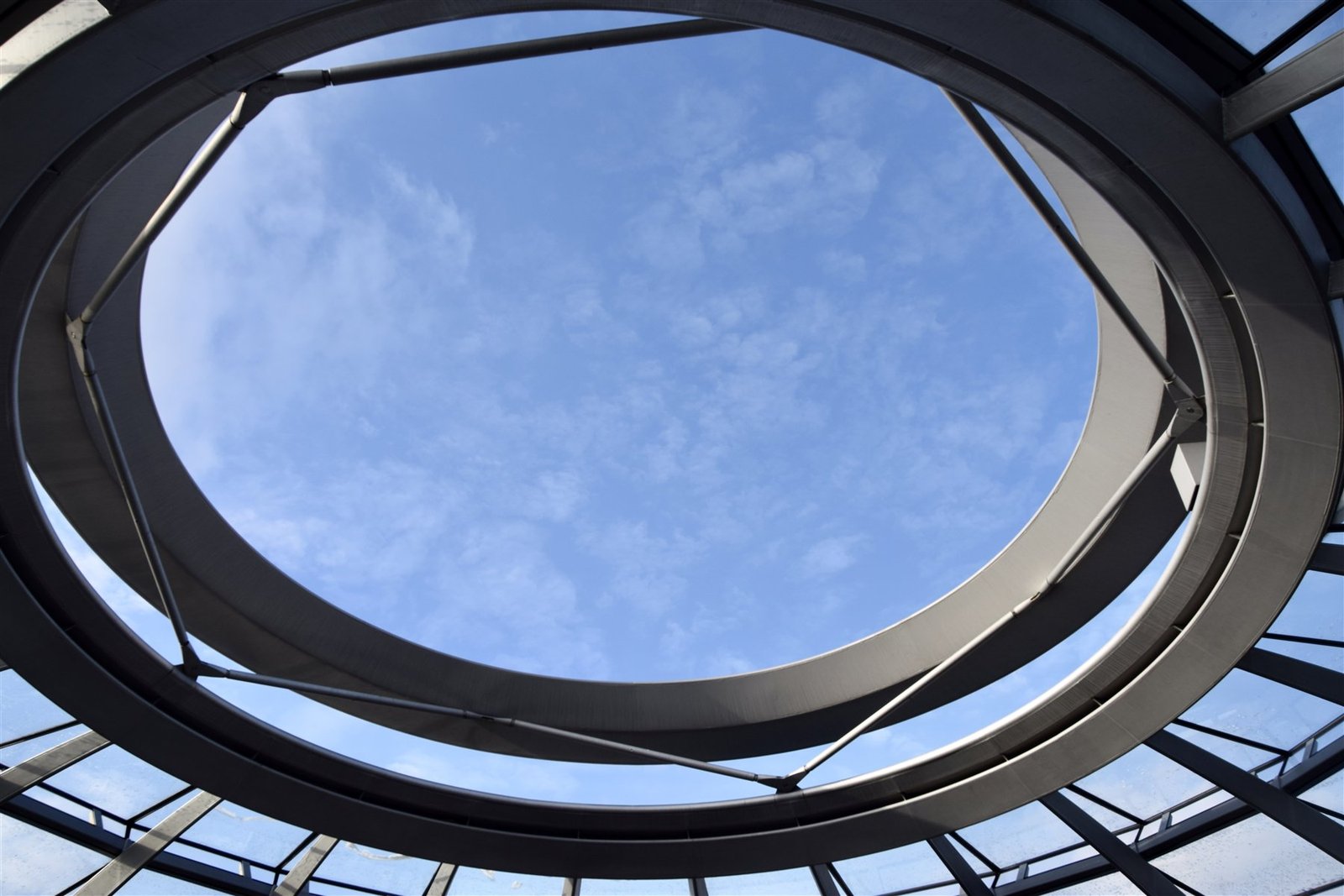
The most recognisable intervention is the great glass dome above the parliamentary chamber.
A mirrored cone brings daylight downward while public ramps spiral upward through the dome.
But the architectural idea goes far beyond spectacle.
Citizens can physically rise above the parliamentary chamber and look down toward their elected representatives.
Government exists beneath the gaze of the people.
At the same time, environmental systems were deeply integrated into the reconstruction. Daylight, ventilation and energy strategies became part of the architectural concept.
The Reichstag shows Foster operating at his best.
Structure, environmental engineering, circulation, history and political symbolism become parts of one architectural idea.
Lightness
Perhaps the word that best describes Foster’s architecture is lightness.
Not necessarily physical lightness alone.
Visual lightness.
Structural lightness.
Conceptual lightness.
His buildings often appear to resist unnecessary mass.
Roofs float. Structures become slender. Glass dissolves boundaries. Components are reduced until the underlying architectural logic becomes visible.
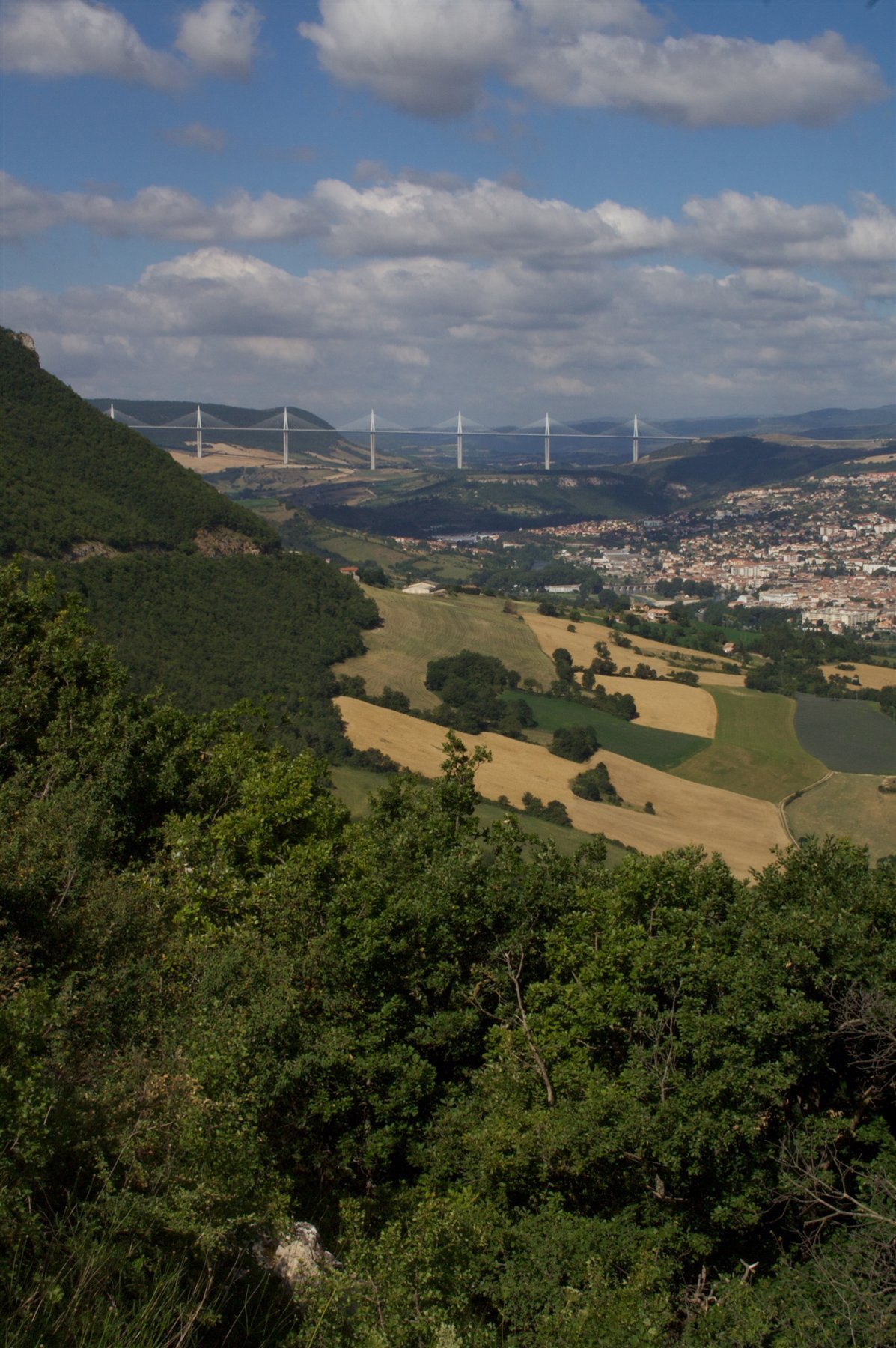
This pursuit reaches an extraordinary scale in the Millau Viaduct in southern France.
The bridge stretches approximately 2.46 kilometres across the Tarn valley.
A structure of such scale could easily dominate the landscape.
Instead, Foster and the engineering team pursued slenderness.
Tall tapered piers rise from the valley while a thin roadway appears almost suspended across the landscape.
The engineering is monumental.
The visual effect is remarkably delicate.
Making enormous structures appear effortless.
Millau: Engineering and Beauty Are Not Opposites
The Millau Viaduct also challenges the artificial boundary between architecture and engineering.
Is a bridge architecture?
For Foster, the question is almost irrelevant.
Infrastructure shapes landscapes, cities and human experience just as profoundly as buildings do.
Therefore infrastructure deserves architectural thought.
The Millau Viaduct demonstrates how efficiency and beauty can emerge from the same structural decision.
The tapered columns express their structural role while simultaneously reducing their visual presence in the landscape.
Nothing appears arbitrary.
The elegance comes from the logic.
This is architecture in which beauty is not applied afterward.
Beauty is discovered inside the solution.
The Vertical City
Foster has also spent decades reconsidering the skyscraper.
The conventional twentieth-century office tower was frequently an environmentally expensive sealed glass box dependent upon enormous mechanical systems.
Projects such as the Commerzbank Headquarters in Frankfurt began questioning that model.
Completed in the 1990s, the tower incorporated gardens, natural ventilation and environmental strategies into the organisation of the high-rise.
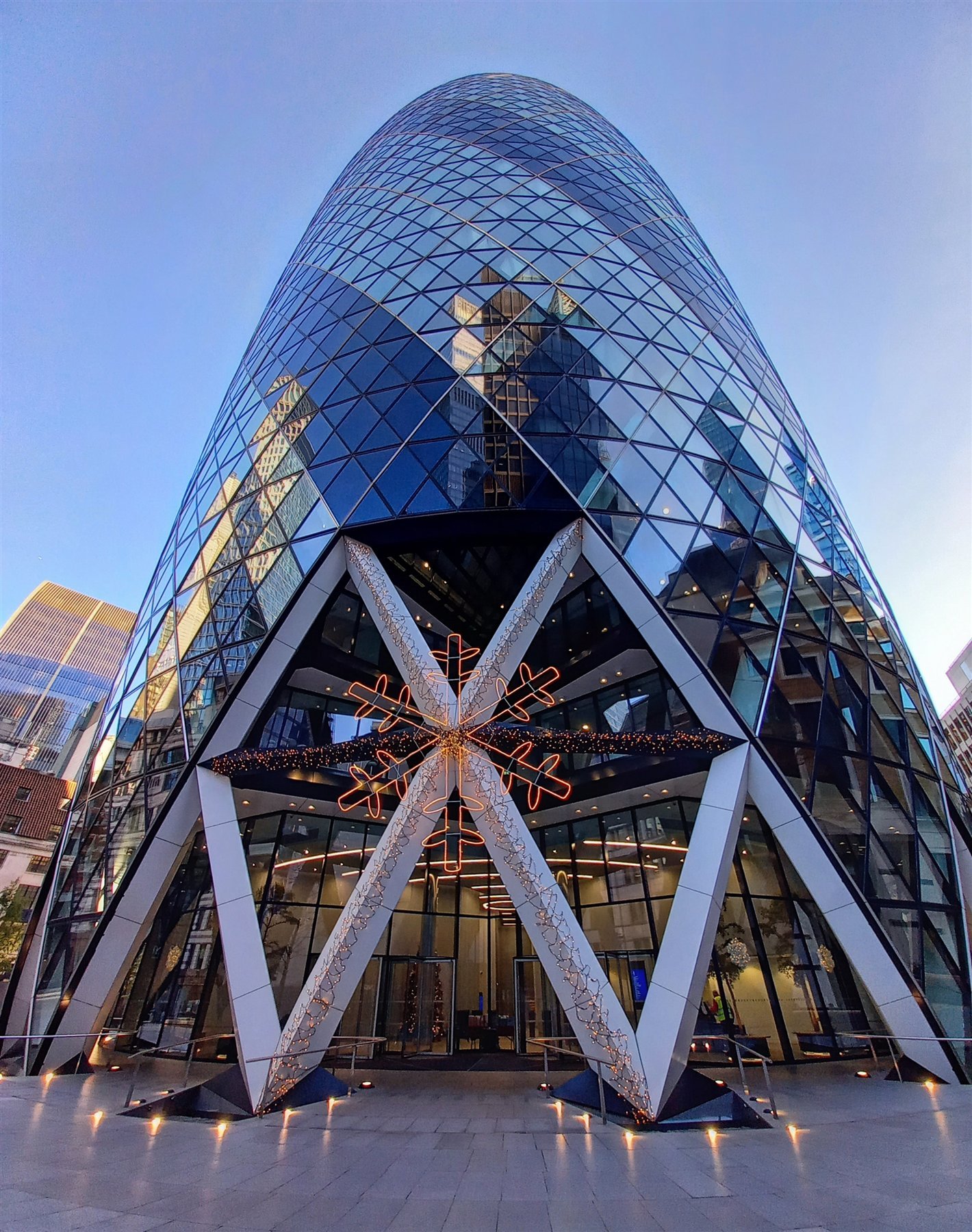
Later, 30 St Mary Axe, popularly known as the Gherkin, pushed these ideas further.
Its aerodynamic form is not simply an attempt to create an iconic silhouette.
The geometry, internal organisation and environmental strategy are interconnected.
The building demonstrated that the skyscraper could be reconsidered not simply as stacked commercial floor plates, but as a more environmentally responsive vertical community.
The architectural image became famous.
The more important achievement lies behind the image.
Architecture and the Machine
Foster’s fascination with machines is visible throughout his career.
Aircraft, automobiles, industrial manufacturing and precision engineering have all influenced his architectural imagination.
Yet Foster’s interest in technology should not be confused with a fascination for gadgets.
What appears to interest him most is performance.
Why should a component contain more material than necessary?
Why should services follow conventional routes?
Why should a roof be heavy?
Why should an airport force passengers through unnecessary changes of level?
Why should a skyscraper automatically depend upon a conventional central core?
These questions resemble the thinking of an engineer, but Foster turns their answers into architecture.
His buildings frequently feel as though every component has been asked to justify its existence.
The Detail and the City
Another remarkable aspect of Foster’s career is scale.
Few architects move comfortably between such extremes.
The practice has designed furniture and door handles, houses, museums, offices, skyscrapers, airports, bridges and entire masterplans.
This suggests an important principle.
Architecture is not defined by the size of the object.
The same discipline of proportion, material, function and human experience applies whether one is designing a handle touched by a hand or infrastructure experienced by millions of people.
The architect must be capable of moving mentally between these scales.
Sustainability Before It Became a Slogan
Today almost every architectural presentation contains the language of sustainability.
Foster’s exploration of environmental performance began much earlier.
Projects from the 1960s and 1970s were already investigating resource conservation, solar energy, wind energy and water recycling.
Later buildings explored natural ventilation, daylight, energy generation and environmentally responsive envelopes.
This does not mean every Foster project is environmentally beyond criticism.
No architect operating at the scale of global airports, corporate headquarters and major infrastructure can escape questions concerning embodied carbon, aviation, consumption and development itself.
But Foster helped establish an important idea:
Environmental engineering should not be added to architecture after the design is finished. It should participate in generating the design.
That distinction remains highly relevant today.
When Foster Meets History
One misconception about technological modernism is that it must reject historical architecture.
Some of Foster’s finest projects demonstrate the opposite.
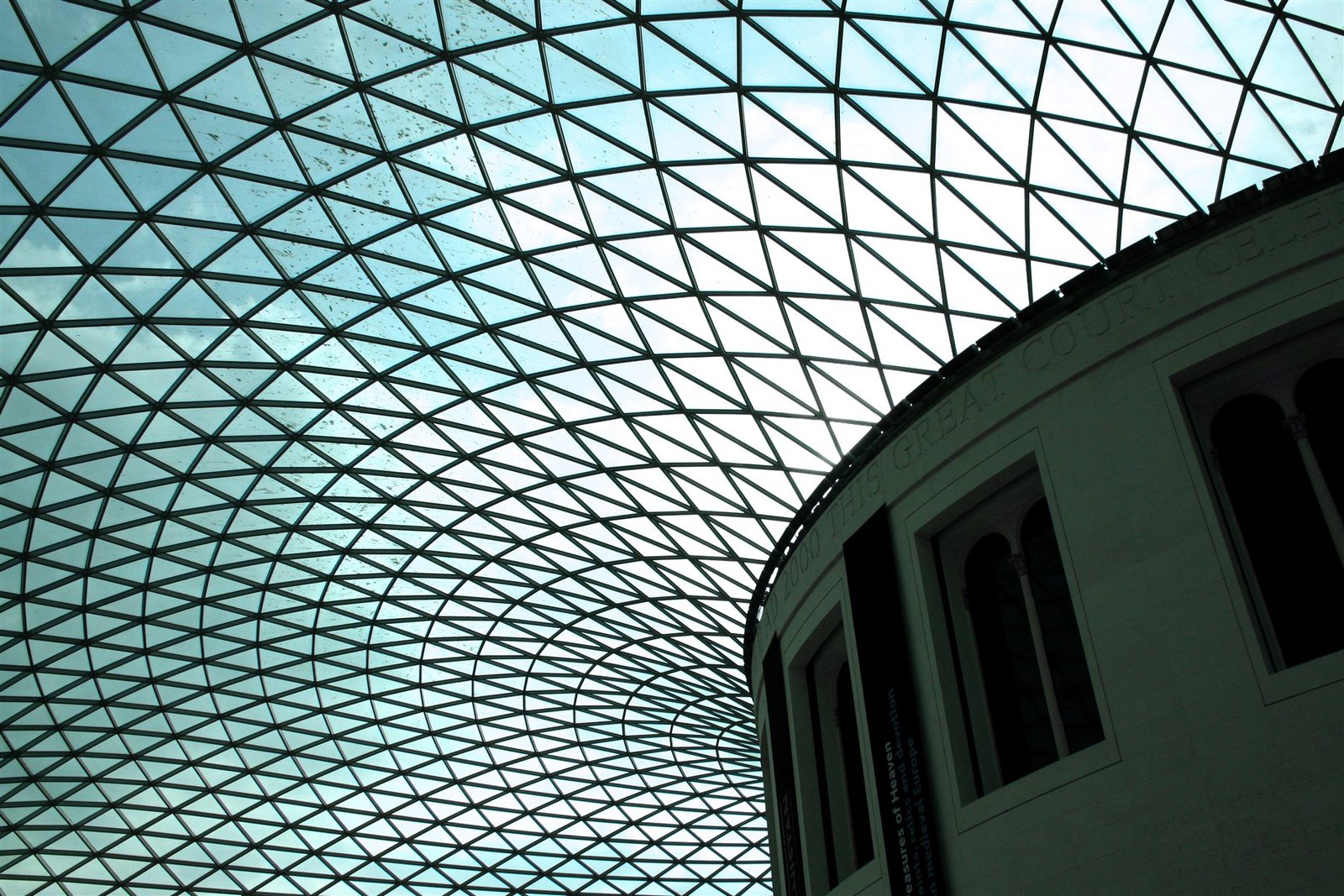
The Reichstag and the Great Court of the British Museum show an architect confident enough not to imitate the past.
The new intervention does not pretend to be historic.
Glass remains glass. Steel remains steel. Old masonry remains old masonry.
The contrast allows both periods to remain readable.
This is a sophisticated form of architectural respect.
Respect for history does not always require stylistic imitation.
Sometimes the strongest respect comes from allowing the historic building and contemporary intervention to speak honestly in their own languages.
The Criticism: Can Technology Become Too Universal?
No serious study of a master architect should become an exercise in admiration alone.
Foster’s work raises legitimate questions.
His architecture helped create an extraordinarily refined international language of glass, steel, engineering and environmental technology.
But can such a language become too universal?
Can a technologically sophisticated building belong equally comfortably in London, Hong Kong, Frankfurt or Abu Dhabi?
And if so, what happens to local architectural identity?
Critics of high-tech and global architecture have questioned whether technological expression can sometimes overshadow context, urban fabric and other artistic dimensions of architecture.
Other critics have observed that the enormous scale of Foster + Partners inevitably produces unevenness. A global practice responsible for an extraordinary volume of work cannot reasonably expect every building to possess the conceptual purity of its masterpieces.
These criticisms deserve consideration.
Because architecture is never only technology.
It is also memory. Climate. Culture. Craft. Material. Place. And belonging.
What Should We Learn from Foster, Rather Than Copy from Him?
This distinction is particularly important for architects practising in Pakistan and other rapidly developing societies.
The lesson from Foster is not that contemporary architecture should consist of steel structures and glass façades.
Copying the appearance would completely miss the intellectual foundation of his architecture.
The real lessons are methodological.
Question assumptions. Understand structure. Collaborate seriously with engineers. Use daylight intelligently. Simplify circulation. Reduce unnecessary material. Integrate environmental thinking from the beginning. Allow technology to solve real architectural problems.
And above all, search for clarity.
But those principles should then respond to our own conditions.
The intense sunlight of Islamabad is not the climate of London.
The streets of Lahore carry different histories.
The mountains and valleys of northern Pakistan demand another architectural relationship with landscape.
Our materials, craftsmanship, social habits and cultural memory are different.
A meaningful Pakistani modern architecture therefore cannot emerge by reproducing Foster’s visual language.
It can, however, learn enormously from his way of thinking.
An Architect’s Reflection: What I Learn from Norman Foster
As an architect, what interests me most about Norman Foster is not the glass, steel or technological image normally associated with his buildings.
It is the discipline behind them.
His strongest projects begin with a clear question and pursue the answer relentlessly.
The structure is not separate from architecture. Engineering is not something that arrives after the design. Environmental performance is not an additional layer. Circulation is not simply a requirement to be accommodated.
Everything participates in the architectural idea.
That approach is deeply instructive.
I also admire Foster’s ability to work at an enormous scale without abandoning the importance of detail. A bridge spanning a valley, an airport serving millions of passengers and a carefully designed building component can all receive the same intellectual attention.
Perhaps most importantly, his career reminds us that architecture must remain optimistic.
Every serious project presents restrictions: economics, engineering, regulations, climate, clients, construction and time.
The architect’s responsibility is not merely to complain about those limitations.
It is to discover possibilities within them.
That is where architecture begins.
For me, Foster’s greatest lesson is therefore not a style.
It is an attitude.
Understand the problem deeply. Remove what is unnecessary. Bring architecture, structure, technology and environment together. Then search for the simplest possible expression of the idea.
That principle can travel anywhere.
The resulting architecture should not.
It should belong to its place.
A Legacy of Optimism
Norman Foster’s career stretches from the experimental optimism of post-war modernism into an age defined by climate change, global cities, digital design and enormous infrastructure.
During that journey, technology changed almost beyond recognition.
Yet the fundamental questions behind his architecture remained remarkably consistent.
Can buildings use fewer resources?
Can structures become lighter?
Can complicated buildings become easier to understand?
Can engineering produce beauty?
Can old buildings accept new life without losing their history?
Can architecture improve everyday experience?
Those questions explain why Foster’s work remains relevant.
The answer was never simply glass and steel.
The answer was integration.
And perhaps that is why, after more than half a century, Norman Foster continues to matter.
Master Architects Series Statement
Master Architects is an ongoing Journal series by Musa Zia Architects, exploring the work, philosophy and enduring lessons of architects who have shaped the way we understand buildings, cities and the human experience of architecture.
Master Architects #01 | Sir Norman Foster
Continue exploring our Projects, About, and Services pages.
Image Credits
HSBC Main Building — Photograph: 鄒延, Wikimedia Commons, CC BY-SA 4.0
Stansted Airport — Photograph: Finlay McWalter, Wikimedia Commons, CC BY-SA 3.0
Reichstag Dome — Photograph: Ank Kumar, Wikimedia Commons, CC BY-SA 4.0
Millau Viaduct — Photograph: Richard Leeming, Wikimedia Commons, CC BY-SA 2.0
30 St Mary Axe — Photograph: Donnchadh H, Wikimedia Commons, CC BY 2.0
British Museum Great Court — Photograph: JJ Jones, Wikimedia Commons, CC BY 3.0