Artificial intelligence has introduced a particular anxiety into creative professions. Writers, artists, designers and architects are watching systems generate convincing work at a speed that was unimaginable only a few years ago. In architecture, the change feels especially immediate. AI can already produce concepts, façades, interiors, master plans and photorealistic visualisations within seconds. It can transform a brief into a sequence of seductive images before a conventional design meeting has properly begun.
The obvious question follows: will AI eventually replace architects?
The question becomes more useful when we distinguish architecture from architectural production. Production includes the drawings, models, images, schedules and information through which a design is developed and communicated. Architecture is the larger act of deciding what should exist, why it should exist, how it should belong to a place and what consequences it will have for the people who inhabit it.
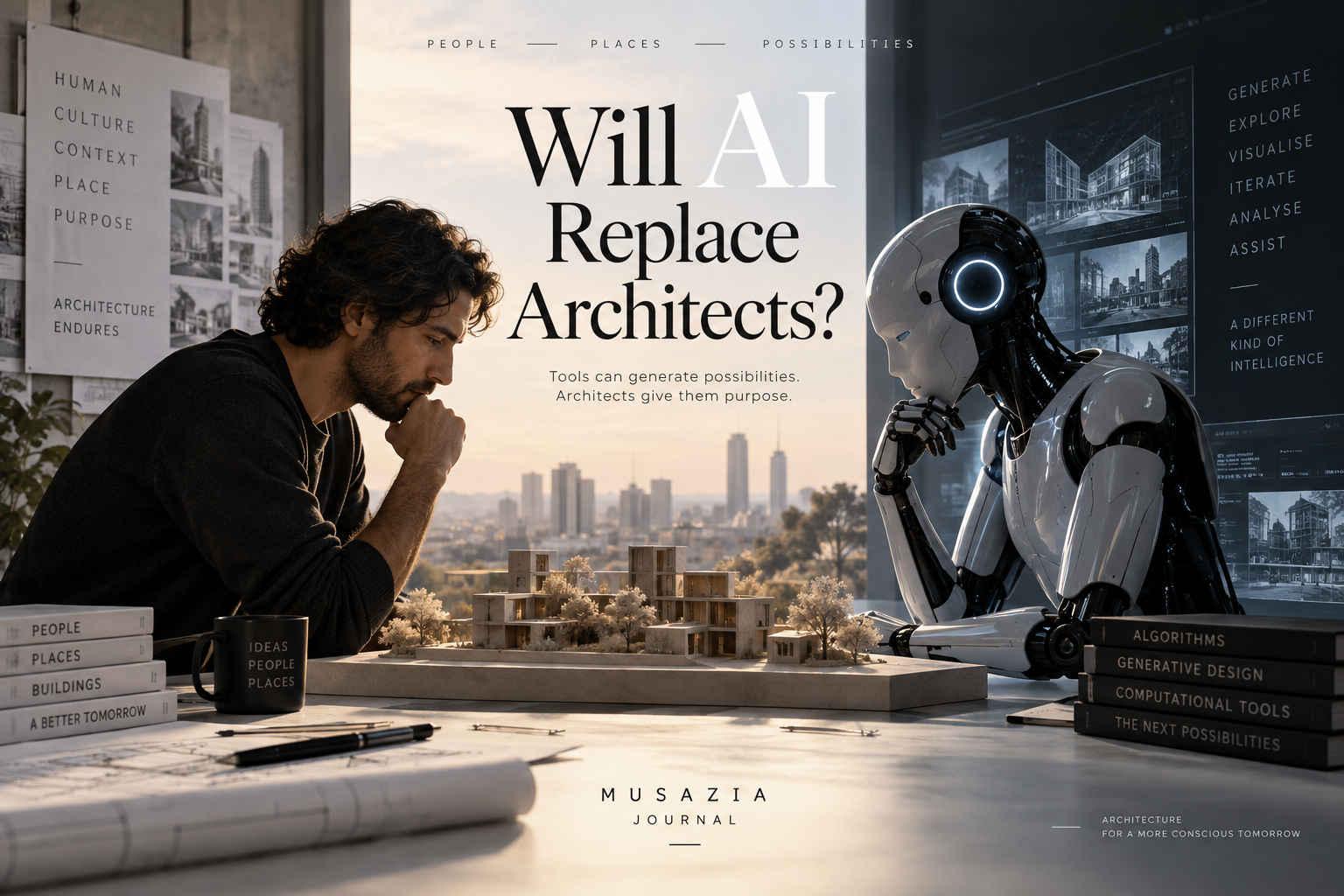
AI can generate possibilities. The architect determines what deserves to be built.
This distinction does not diminish the significance of AI. It clarifies where the profession is likely to change most quickly, and where human responsibility remains essential.
Architecture Is More Than Producing Drawings
Architecture is often misunderstood as the production of plans, models and attractive images. Those outputs matter, but they are evidence of a much more complicated process. A practising architect works between client aspirations, site, climate, culture, economics, planning regulations, structure, engineering, materials, construction methods, contractors, authorities and human behaviour.
These forces rarely point in the same direction. A client may want openness while the climate demands protection. A dramatic span may conflict with budget or construction capacity. Planning rules may resist the best relationship between a building and its street. A material that appears convincing in a rendering may weather badly, be unavailable locally or require maintenance the owner cannot sustain.
The architect continually negotiates between these realities. Design is not simply the generation of a form. It is the patient construction of relationships among many incomplete, changing and sometimes contradictory demands. AI can assist with analysis and reveal options within each area, but architectural judgement lies in understanding how the parts affect one another. It also requires accepting responsibility for the decision that follows.
What AI Will Probably Replace
We should be realistic. AI will automate or substantially reduce a great deal of repetitive architectural work. Concept variations, precedent research, early massing studies, rendering, material experimentation and presentation graphics are already changing. Documentation assistance, quantity and data analysis, drawing coordination and increasingly sophisticated BIM workflows will follow.
Tasks that once occupied several days may be completed in hours or minutes. A team may test dozens of façade rhythms before lunch, compare planning arrangements against measurable criteria, or generate a coherent presentation from information already contained in a model. Technical systems may identify drawing conflicts, inconsistent annotations or missing information before a human review begins.
This should not be treated as a tragedy. Architecture has always adopted instruments that reduce repetitive labour and extend the designer’s reach. The important point is that AI is transforming architectural production. Some tasks will disappear, others will be compressed, and new forms of supervision will emerge. The profession must be honest about this change without confusing the automation of a process with the disappearance of architectural thought.
The Architectural Office Will Change
Traditional offices have depended heavily on junior architects, draftsmen and visualisation specialists for production. Experience was often accumulated through that work: drawing details, revising plans, building models and observing how senior architects made decisions. AI may significantly alter this structure.
Smaller practices may achieve levels of production that previously required much larger teams. A compact office with strong design leadership and intelligent systems could investigate, document and communicate projects with remarkable speed. For practices undertaking diverse architectural projects, that capability can create more time for research, client dialogue, site observation and design refinement.
Yet increased productivity creates increased expectations. Clients may expect more alternatives, faster visualisation and quicker decisions. Compressed schedules can simply fill with additional demands. Technology does not necessarily make architecture easier. It changes where professional value lies. The valuable architect will not be the person who produces the greatest quantity of material, but the person who knows what information matters and when a decision is mature enough to be made.
The Danger of Beautiful AI Architecture
Online platforms now contain an enormous quantity of spectacular AI-generated architecture. Towers dissolve into clouds, interiors merge with forests, structures twist across impossible spans and materials behave with dreamlike freedom. Many of these images are visually extraordinary. Very few have confronted gravity, structure, waterproofing, drainage, fire safety, circulation, services, construction sequencing, local regulations, material behaviour, maintenance, budget or human occupation.
Architecture begins where the image ends.
A building must stand, function, age, respond to climate, accommodate human life and ultimately be constructed. AI can imagine without consequences. Architects cannot.
This is the essential distinction between architectural imagery and architecture. An image can suspend disbelief. A building has to resolve it. The camera sees one selected moment; the inhabitant experiences heat, sound, movement, privacy, thresholds, awkward corners, changing weather and years of use.
A beautiful image is not necessarily a good building. It may be the beginning of an inquiry, just as a sketch can be, but it is not proof of architectural quality. When imagery becomes too easy to produce, the ability to interrogate it becomes more important. What is carrying the load? Where does the rain go? How does a person enter? Can this detail be built by available trades? What happens after ten summers? These questions are not obstacles to creativity. They are the conditions through which architectural imagination becomes real.
More Options Do Not Mean Better Architecture
AI will allow architects to generate enormous numbers of alternatives. That abundance can be valuable, especially at the beginning of a project when assumptions should be tested. But quantity does not automatically produce quality. A hundred plausible options can create noise as easily as insight.
The important architectural skill becomes judgement. Which option belongs to this site? Which responds to climate? Which creates meaningful space? Which can actually be built? Which will still feel relevant twenty years from now?
Architectural intelligence increasingly involves the ability to select, edit, reject and refine. Rejection is especially important. Design acquires strength when unnecessary ideas are removed and the remaining decisions support one another. An algorithm may rank options according to stated criteria, but the architect must still decide whether the criteria are sufficient and whether the outcome has coherence, dignity and meaning.
From Software Operator to Design Thinker
For decades, architects have increasingly been judged by software proficiency. AutoCAD, three-dimensional modelling, BIM, rendering packages and visualisation tools became valuable professional skills. They still are. Yet AI may gradually reduce the competitive advantage of simply knowing how to operate software.
The architect’s deeper value may return to design thinking, spatial intelligence, proportion, material understanding, technical knowledge, cultural awareness, communication, taste, judgement and authorship. These abilities are slower to develop because they are not commands learned from a menu. They emerge through observation, construction experience, criticism, travel, reading, drawing and sustained attention to buildings.
Technology should amplify these abilities. A designer with weak judgement can use AI to produce more weak decisions, only faster and with greater polish. A thoughtful architect can use the same systems to investigate more deeply, communicate more clearly and reserve energy for the parts of a project that require genuine attention.
Lessons From Previous Technological Revolutions
Architecture has passed through several technological revolutions. Hand drafting gave way to CAD. Physical models were supplemented by digital modelling. Rendering evolved from a specialist process into real-time visualisation. BIM transformed coordination and documentation.
None of these eliminated architects. Each changed what architects spent their time doing and shifted the skills valued within an office. The transition was never entirely comfortable, and some established roles contracted, but the profession adapted.
AI is potentially more disruptive because it enters the creative process itself. It does not only draw a line efficiently; it proposes what the line might become. That demands a more alert response. Architects should neither dismiss AI as a passing fashion nor surrender architectural thinking to it. The history of the profession suggests that tools become most useful when their possibilities are understood alongside their limits. The lives and work examined in the Master Architects series also remind us that enduring practice is shaped not by a single instrument, but by a sustained architectural position.
The Architect and AI
The positive future is not difficult to imagine. AI can become an architectural collaborator or, perhaps more accurately, a powerful instrument. An architect could use it to investigate massing, façade alternatives, materials, lighting, landscape, environmental strategies, planning configurations, construction information, visualisation and presentation.
The architect remains responsible for establishing the problem, evaluating the results and directing the design. This matters because a poorly framed question can produce an impressive but irrelevant answer. Before requesting options, the architect must understand the site, the people, the constraints and the ambitions well enough to define what should be explored.
A powerful instrument does not automatically create a great musician. It expands the range of sound available to someone who has developed the ability to listen, compose and perform. Similarly, increasingly powerful architectural tools do not automatically create great architecture. Their value depends on the intelligence, discipline and intention with which they are used.
What Kind of Architect Will Survive the Age of AI?
This is the more important question. The future architect will need to understand architecture deeply and construction practically. They will need strong design judgement, curiosity about emerging technology, sensitivity to people and place, and an identifiable architectural point of view.
Technical fluency without architectural knowledge will be fragile because the tools will continue to change. Architectural knowledge without technological fluency may become increasingly difficult to deliver competitively. The strongest position lies in combining both. Architects who understand what a building must do and know how to direct new systems will become considerably more capable.
This combination also requires confidence to remain critical. Adapting does not mean accepting every output or adopting every new platform. It means learning enough to decide which tools serve the work. The professional identity described on the Architect Musa Zia page is grounded in responsibility to people, context and construction. AI should strengthen that responsibility, not dilute it.
The central thesis is therefore direct: AI will not replace architects. But architects who learn to work intelligently with AI may replace architects who refuse to adapt.
Architecture Remains Human
Buildings are ultimately created for human beings. Architecture deals with memory, belonging, privacy, community, ritual, identity, comfort, beauty and our relationship with place. A home holds the patterns of family life. A school influences how children gather and learn. A public building expresses an idea of civic dignity. A street can create encounter or isolation.
These matters cannot be reduced to image generation. AI can analyse patterns and generate solutions, but architecture derives meaning from human intention and lived experience. It depends on empathy for people who may not speak the language of design, awareness of cultural habits that are rarely captured by data, and the ability to recognise qualities that cannot always be measured.
This is not an argument for human intuition without evidence. Good architects use information, calculation and technical expertise. It is an argument for remembering why those resources are brought together. Architecture is not only the optimisation of performance. It is the creation of places in which life will unfold.
Will AI Replace Architects?
Probably not.
But it will replace many processes architects currently perform, transform architectural offices and redefine what clients expect from the profession. Architects who ignore AI may find themselves increasingly disadvantaged. Architects who merely allow AI to make design decisions for them may lose something equally important: authorship.
The future therefore belongs neither to the architect alone nor to the machine alone. It belongs to architects who know what technology should do, what it should not do and why. The continuing essays in the Musa Zia Journal return to this responsibility because the future of architecture depends as much on clarity of purpose as it does on new capability.
The future architect may draw less, model faster and delegate enormous amounts of production to machines. But the responsibility to understand people, place and purpose will remain profoundly human. AI may change how architecture is produced. It does not have to determine why architecture exists.
Architect Musa Zia
Musa Zia Architects
Islamabad, Pakistan