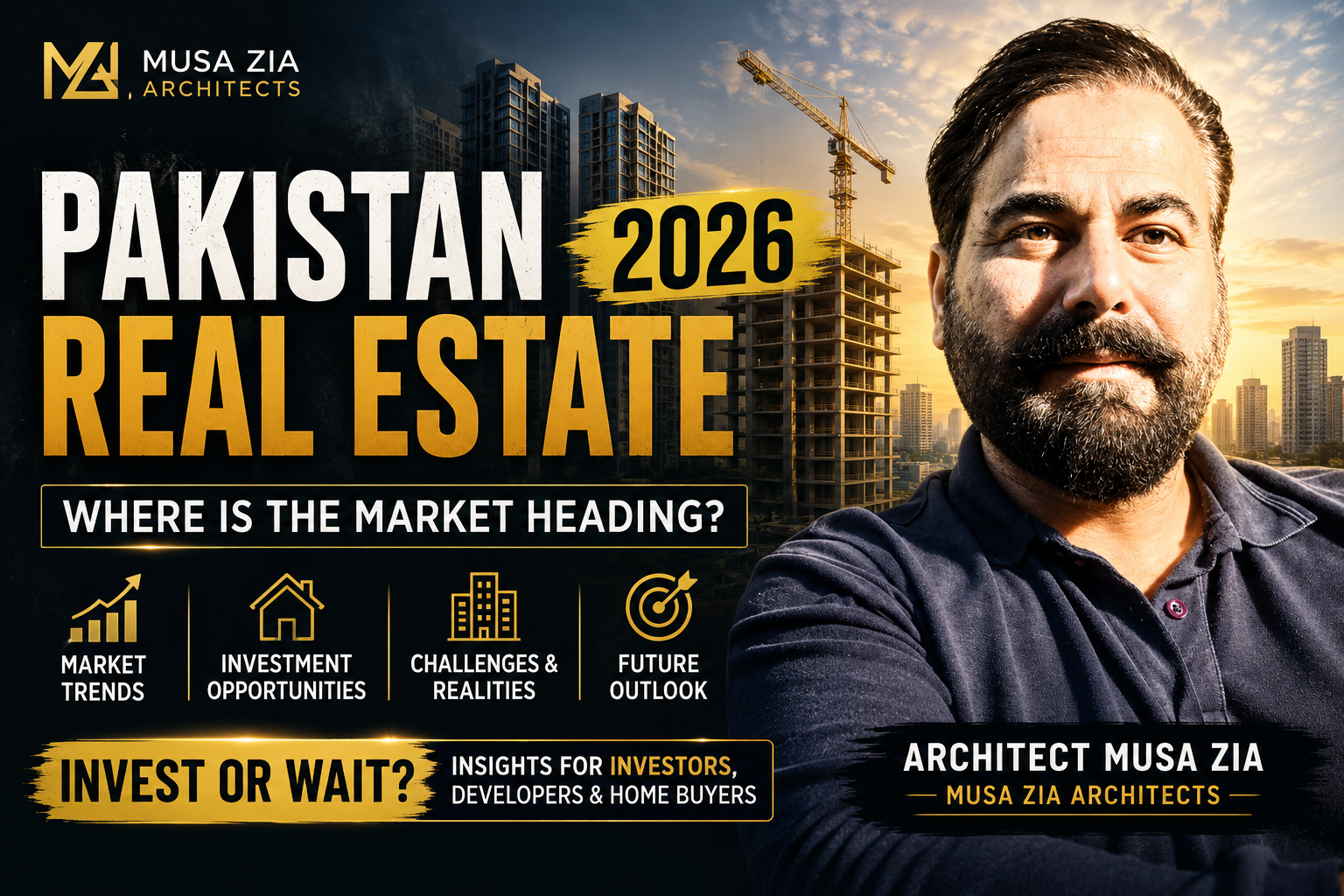
Pakistan’s real estate sector is evolving rapidly, with changing investment patterns, rising construction costs, new development models and growing demand for better-planned residential and commercial projects.
In this vlog, Architect Musa Zia discusses the current direction of Pakistan’s real estate market, key challenges, investment opportunities and the role of architecture in creating long-term property value.
Watch the full discussion below.
The Future of Real Estate Development in Pakistan
The future of Pakistan’s real estate sector will increasingly depend on better feasibility studies, thoughtful architectural planning and developments that provide genuine long-term value.
At Musa Zia Architects, we believe architecture, commercial planning and development strategy should be considered together from the beginning of a project.
Designing Buildings, Creating Legacies.
Opportunities in Pakistan’s Real Estate Sector
Opportunities continue to exist in residential, commercial, hospitality and mixed-use development across Islamabad, Rawalpindi, Lahore, Karachi and emerging markets throughout Pakistan.
Tourism destinations such as Murree, Muzaffarabad and northern Pakistan also present opportunities for hotels, resorts, serviced apartments and destination-oriented developments, provided that architecture responds appropriately to climate, landscape, topography and local context.
Architecture and Real Estate Value
Good architecture is not simply about appearance. Efficient planning, appropriate floor areas, strong circulation, good visibility, parking provision, attractive public spaces and a clear architectural identity can significantly improve the desirability and commercial performance of a development.
For developers, the objective should not only be to maximise built-up area, but to create the most valuable and sustainable use of the site.
Real Estate in Pakistan: What Is Changing?
Pakistan’s property market has traditionally been driven by land ownership and capital appreciation. However, the sector is gradually becoming more sophisticated. Developers, investors and property owners are increasingly considering commercial feasibility, location, architecture, accessibility, parking, infrastructure and long-term revenue potential before committing to a project.
Residential developments, commercial centres, apartments, hotels and mixed-use projects all require careful planning if they are to remain commercially successful over time.
The Role of Architects in Real Estate Development
Architecture has a direct relationship with the commercial potential of real estate. Before a development reaches the construction stage, important decisions regarding land use, building orientation, circulation, parking, floor planning, accessibility and the relationship between different functions can determine how successfully a property performs.
For commercial developments, factors such as shop visibility, pedestrian movement, efficient floor plates and attractive public spaces can influence footfall and rental potential. In residential projects, privacy, natural light, ventilation, views, circulation and efficient use of space can significantly affect desirability.
Working with an experienced architect during the early feasibility and planning stages can therefore help developers identify opportunities and potential problems before substantial investment is committed to construction.
At Musa Zia Architects, our architectural practice in Islamabad works across residential, commercial, hospitality and mixed-use developments in Pakistan, with an emphasis on combining architectural identity with functional and commercial considerations.
From Land to a Successful Development
Owning valuable land does not automatically guarantee a successful real estate project. One of the most important decisions for any developer is determining what should actually be built on a particular site.
A site may potentially accommodate apartments, offices, retail spaces, a hotel, mixed-use development or a combination of these functions. The appropriate solution depends upon location, surrounding development, accessibility, market demand, planning regulations and the financial objectives of the developer.
This is why architectural feasibility should ideally begin before the final development programme is fixed. Exploring alternative concepts can reveal opportunities to improve usable area, circulation, parking capacity and the overall commercial potential of the property.
The strongest real estate developments are therefore not necessarily those with the greatest amount of construction. They are projects where architecture, market requirements and long-term development strategy work together.