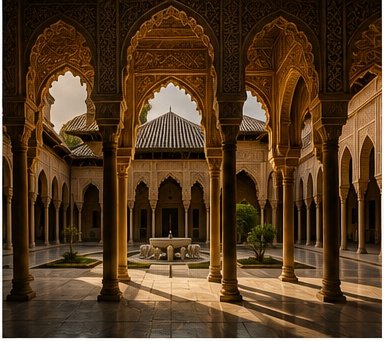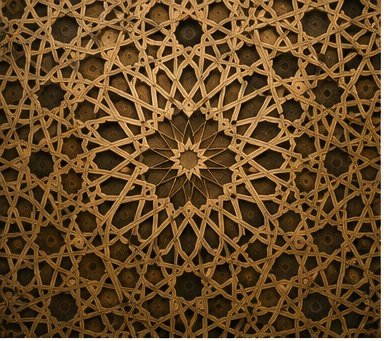

Geometry is present in every building, whether it is acknowledged or not. A wall establishes a line; a column creates a point of measure; a room sets out a field of proportion. At its most useful, geometry is not applied decoration but an ordering principle—a means of bringing structure, space, movement and detail into a coherent relationship.
This distinction is important. Pattern can enrich architecture, yet geometry has a deeper role than the making of patterned surfaces. It can determine how a plan grows from a centre, how one space leads to another, how structural bays repeat, how openings are placed and how different scales of a building remain related.
Measure and proportion
Proportion begins when one dimension is understood in relation to another. The width of a bay may inform the size of an opening; the height of a room may establish the scale of its wall divisions; a structural module may guide furniture, paving and ceiling elements. A consistent proportional logic does not make every part identical. It gives variation a common ground.
Architects have used many proportional systems across different periods and cultures. Their value is not found in the automatic application of a supposedly perfect ratio. It lies in disciplined comparison. Proportion encourages the designer to ask whether a space feels compressed or generous, whether an elevation possesses rhythm and whether a detail belongs to the whole.
Geometry becomes architectural when measure is transformed into spatial experience.
Grids: visible and invisible
A grid is among the most practical forms of geometric order. It can coordinate structure, circulation, partitions and services, reducing conflict between systems. In an urban project, it may connect the scale of a façade to the repeated dimensions of rooms. In a house, it can align courtyards, walls and openings without becoming visually explicit.
Grids need not produce monotony. A regular field can be interrupted to mark an entrance, create a gathering space or respond to a view. The strength of the system makes these departures legible. Without an underlying order, exceptions feel accidental; within an order, they become significant.
Circles, polygons and centres
The circle establishes centre and continuity. Polygons allow the circle’s radial order to be translated into constructible edges and repeating units. These geometries can organise domes, courtyards, halls, gardens or smaller elements of enclosure. Their architectural effect comes from how they direct attention and movement.
A centred space can create stillness, while a sequence of shifted centres can generate procession. Radial geometry may gather people around a shared focus. Polygonal transitions can mediate between a square room and a circular covering form. Such operations are spatial and structural before they are symbolic.
Symmetry and balance
Symmetry offers clarity. It allows an entrance, axis or principal room to be understood immediately. Yet absolute symmetry is not the only path to harmony. Many sites require adjustment: one edge meets a street, another opens to landscape; one orientation receives harsh sun, another a desirable view. Architecture can retain balance while responding asymmetrically to these conditions.
The useful question is not whether a composition mirrors itself, but whether its parts are held in intelligible tension. A heavy wall may be balanced by a deep void. A repeated colonnade may terminate at a singular stair. Geometry provides the reference against which these differences become meaningful.
Repetition, variation and pattern
Repetition establishes rhythm. When a unit is repeated, the eye recognises sequence and anticipates continuation. Variation then introduces emphasis, hierarchy or adaptation. This principle operates in structural frames, arcades, windows, screens and paving, as well as in geometric ornament.
Pattern is most convincing when it participates in architectural performance. A screen can filter light, support privacy and temper heat while also creating a changing field of shadow. A tiled surface can protect a wall and establish measure. A ceiling pattern can reveal the geometry of a span. Beauty and use need not be separated.
Islamic geometric traditions
Across Islamic architectural traditions, geometry has been developed with extraordinary rigour and variety. Repeated stars, polygons, interlacing lines and proportional fields appear in surfaces, screens, floors, domes and spatial organisations. These works belong to diverse regions and periods; they should not be reduced to a single style or a collection of motifs.
The architectural lesson lies partly in the relationship between rule and invention. A limited set of geometric operations can produce extensive variation while maintaining unity. Pattern can move across scales, from the order of a courtyard to the subdivision of a panel. It can frame calligraphy, respond to material techniques and register the movement of light.
Respectful contemporary engagement requires understanding rather than extraction. A historic pattern should not be copied simply to signal cultural identity. Designers can instead study the principles that make geometric work coherent: construction lines, repetition, hierarchy, craft, surface depth and the integration of pattern with space and climate.
Hierarchy through geometry
Not all spaces carry equal importance. Geometry can establish hierarchy by changing scale, orientation or degree of enclosure. A narrow bay may lead to a larger chamber. A secondary grid may resolve service spaces around a primary hall. A shift in pattern density may announce a threshold.
Hierarchy helps people understand where they are. It creates a spatial grammar: approach, entrance, transition, gathering and retreat. When this grammar is clear, wayfinding can feel intuitive without an excess of signs or formal gestures.
From measurable form to contemplative experience
Geometry is measurable, but architecture is lived. The dimensions of a courtyard can be recorded precisely; its experience also includes echo, temperature, shadow, distance and the pace of movement. Mathematical order becomes meaningful when it supports these sensory conditions rather than remaining an abstract diagram.
Repeated forms can create calm because they offer continuity. A centred composition can focus attention. Filtered light moving across a geometric screen can make time perceptible. These effects do not require unsupported claims about hidden meanings. They emerge from the direct relationship between order, material and perception.
A disciplined freedom
Geometry does not remove creativity. It provides a framework within which decisions can be tested and related. The designer is free to adjust, interrupt and layer the system, but each move gains strength from the order it engages.
When mathematics becomes architecture, number is no longer merely calculated and pattern is no longer merely seen. Geometry begins to organise weight, light, movement and attention. It becomes a bridge between the precision of measurable form and the open-ended character of human experience—a disciplined foundation for visual harmony and contemplative space.