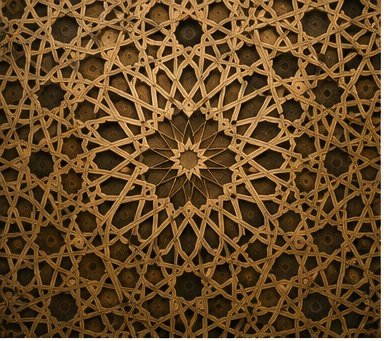
A patterned ceiling, a tiled courtyard or a pierced stone screen can appear endlessly complex, yet the experience often begins with a small number of clear decisions. A circle is drawn. A square is placed within it. Lines connect centres, corners and points of intersection. From those elementary acts, a field of stars, polygons and interlocking paths begins to grow.
In Islamic architecture, geometry is frequently described as decoration. That description is not entirely wrong, but it is incomplete. Geometry can organise surfaces, establish proportion, guide craftsmanship and give coherence to the relationship between part and whole. Its value lies not in a supposed secret code, but in the disciplined way mathematical order becomes architectural experience.
From simple figures to complex order
The circle and square are among the most useful starting figures. A circle establishes a centre and an equal distance from that centre. A square introduces direction, corner and axis. Triangles, hexagons, octagons and other polygons can then be constructed through subdivision and rotation. The resulting patterns may look spontaneous, but their logic is usually precise enough to be reconstructed with a compass, straightedge and a clear sequence of operations.
Star patterns emerge when polygonal grids are extended, overlapped or connected. An eight-pointed star may grow from two rotated squares; more elaborate arrangements can develop from networks of polygons whose proportions have been carefully coordinated. The aim is not complexity for its own sake. Successful patterns remain legible at several scales: one may first perceive a continuous field, then a family of stars, and finally the individual joints made by a tile setter, woodworker or plaster craftsman.
Tessellation, symmetry and repetition
Tessellation means covering a plane with repeated shapes without leaving unintended gaps. In architectural work, this mathematical principle becomes practical. Tiles must meet, carved panels must align, and ornamental bands must turn corners without losing their rhythm. Repetition makes such systems economical and buildable, while variation prevents them from becoming inert.
Symmetry provides stability, but Islamic geometric design is rarely only a matter of mirroring one motif. Rotational symmetries, shifts and alternating sequences allow a pattern to expand across a wall, dome or screen. The eye recognises order without necessarily locating a single dominant object. This helps explain the impression of continuity that many historic interiors produce.
The suggestion of infinity is therefore visual rather than a claim about hidden mathematics. A bounded panel may imply that its pattern could continue beyond the frame. At an edge, the geometry often appears deliberately cut rather than conclusively finished. The surface becomes a fragment of a larger imaginable order.
Unity within multiplicity
A geometric field can hold many distinct elements without allowing them to become unrelated. Large stars contain smaller polygons; lines pass from one centre to another; positive shapes and the spaces between them are designed together. This is unity within multiplicity in an architectural sense: difference is preserved, but every part participates in a shared system.
That quality has a spatial consequence. Repeated geometry can connect bays along an arcade, organise the soffit of a dome, modulate daylight through a screen or establish the scale of a courtyard elevation. Pattern is most convincing when it reinforces the architecture instead of being pasted onto it. The same regulating logic may inform a plan, a structural rhythm and the treatment of a surface, even when each is expressed differently.
Proportion, craft and material
Geometry becomes architecture through material resistance. Glazed tiles have thickness and joints. Timber expands and contracts. Stone cannot be cut into infinitely fine lines. Plaster permits delicate relief but still depends on the skill of the hand. Historic geometric work is therefore evidence of collaboration between mathematical conception and practical craft.
Proportion governs the translation. A pattern suitable for a manuscript border may be too fine for a facade seen across a public square. A carved screen must balance openness with strength and privacy. A tiled dado meets the scale of the body differently from a patterned vault overhead. Good design adjusts the underlying system to distance, light, material and use.
This is why expensive finishes cannot compensate for weak order. When modules, centres and margins have not been resolved, ornament tends to expose the confusion. When the proportions are sound, modest materials can achieve remarkable dignity.
Geometry across the Islamic architectural tradition
The Islamic world encompasses many regions, periods and building cultures, so no single geometric language represents it all. The brick patterns of Central Asia, the carved stucco and tilework of the Alhambra, the mosaic traditions of Morocco, the stone screens of South Asia and the timber ceilings of parts of the Ottoman world differ in material, climate and technique. Their geometries must be understood within those specific contexts.
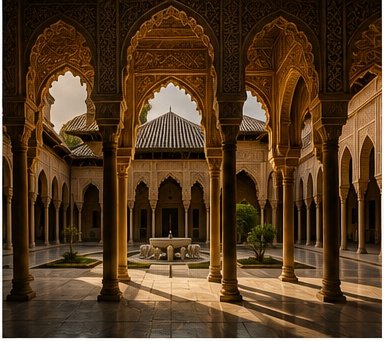
Yet broad continuities are visible. Craftspeople repeatedly used rule-based construction to coordinate repetition and variation. Geometry worked alongside calligraphy, vegetal ornament, structure, water and light. At the Alhambra, for example, patterned surfaces gain meaning through courtyards, reflections, shade and movement; they are part of an environmental and spatial composition.
Architectural order, not applied spectacle
Contemporary designers can learn from this tradition without copying historic motifs. The deeper lesson is to begin with relationships: centre and edge, solid and void, module and whole, repetition and interruption. Parametric tools can generate thousands of variations, but the architect must still decide which geometry belongs to the site, material and human scale.
The related question of centre and orientation becomes especially important in the architecture of the Kaaba, where established religious meaning must be distinguished carefully from speculative numerical interpretation. Elsewhere, a screen may be justified by shade and privacy before it becomes an image.
Islamic geometric design remains compelling because it joins intellectual clarity with patient making. Circles, squares and polygons are not ends in themselves. Through proportion, repetition, craft and light, they become a framework in which architecture can hold complexity without disorder and suggest continuity without denying the limits of the built work.