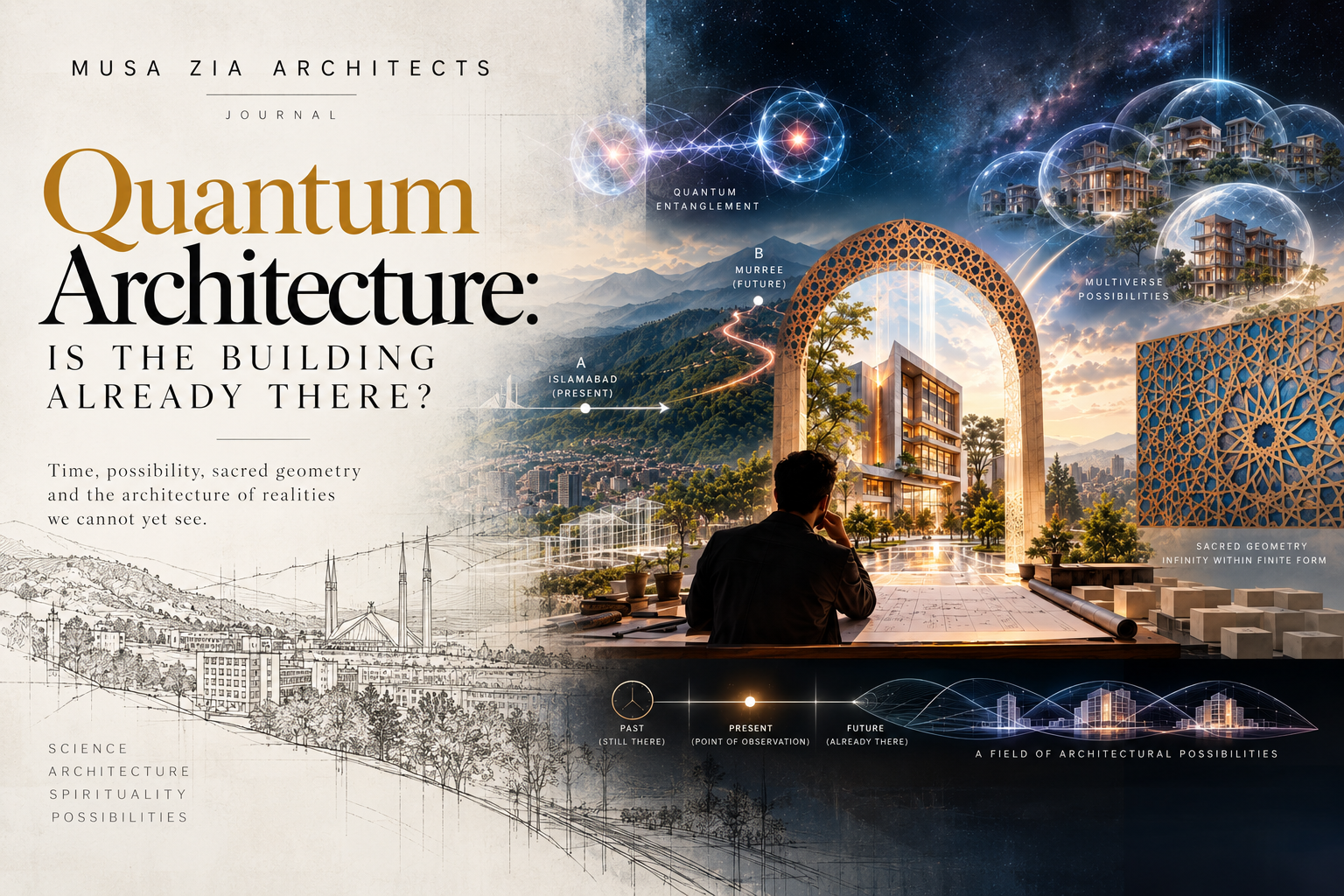
Time, possibility, sacred geometry and the architecture of realities we cannot yet see.
Suppose I am sitting in Islamabad today and intend to travel to Murree tomorrow. From where I stand, Murree belongs to my future. Yet Murree does not come into existence tomorrow. It is already there: the ridgeline, the roads, the trees, the buildings and the cold air are present whether or not I have begun my journey.
Tomorrow I travel from Point A to Point B and arrive there. When I return to Islamabad, Murree becomes part of my past journey. But Murree itself has not disappeared. It remains where it was.
This simple journey opens a difficult question. What if past, present and future are not realities that continuously appear and disappear, but positions from which consciousness experiences a greater reality?
That question is not a scientific conclusion. Spatial existence and temporal existence are not identical, and a road journey cannot prove a theory of time. It is a philosophical doorway. Architecture gives us another way to walk through it.
The Journey from A to B
If Point B already exists spatially, what exactly do we mean when we say that arriving there belongs to the future?
Usually we mean something modest: I am not there now, but I expect to be there later. The future describes my relationship to Murree, not Murree’s absence from reality. My movement changes my position and my experience. It does not summon the destination into existence.
Time is not merely a second road laid beside the first. Physics treats space and time differently in important respects. Nevertheless, the Islamabad–Murree journey loosens an assumption hidden in ordinary speech: that whatever is future to us must therefore be nothing. Perhaps “future” sometimes names a limit of our present access rather than a declaration of non-existence.
Does the Future Already Exist?
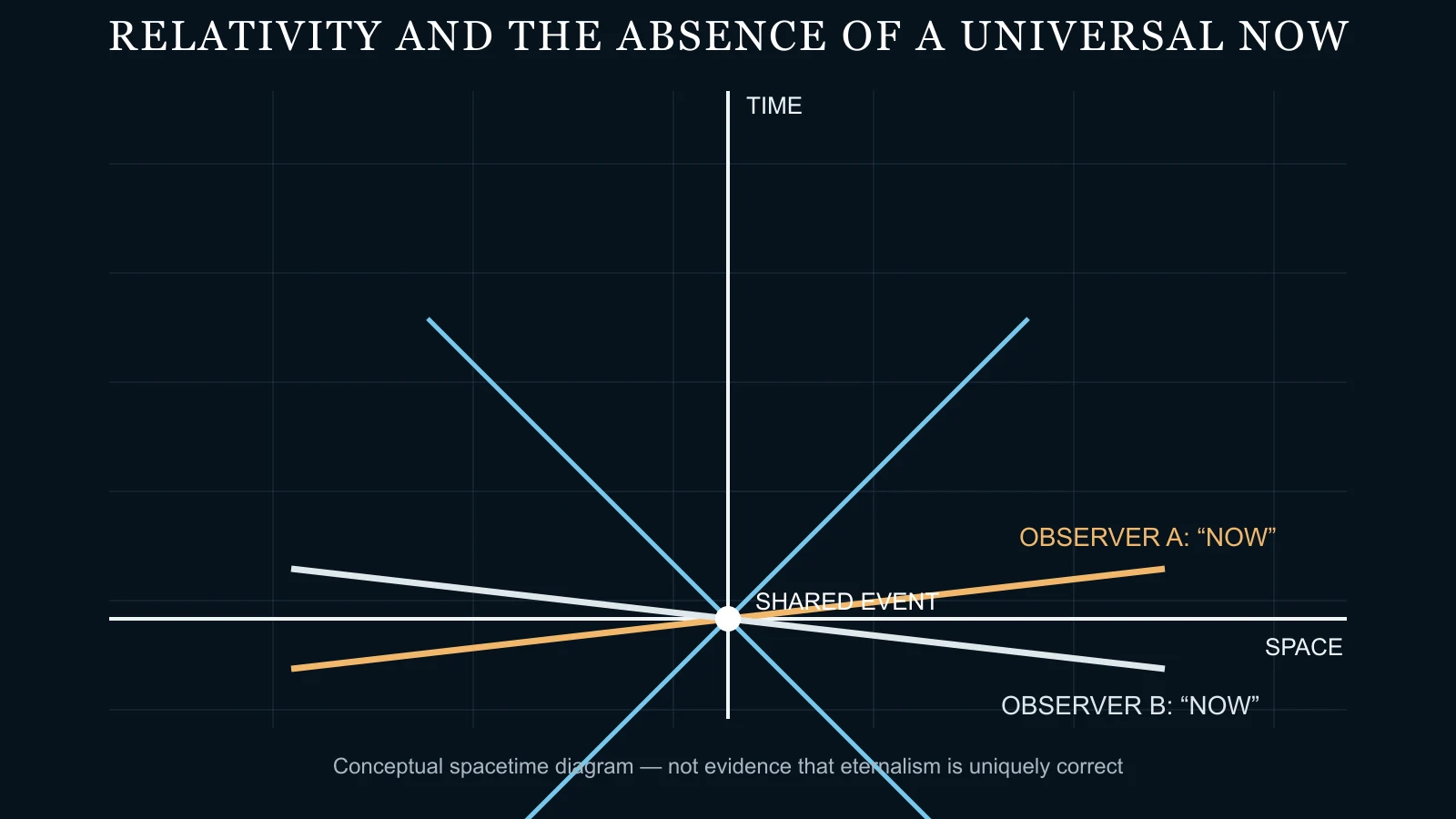
Relativity changed the scientific description of time by joining space and time within spacetime and by challenging the intuition that the universe possesses one absolute, universal “now.” Events judged simultaneous in one reference frame need not be simultaneous in another. This is established physics.
What follows philosophically is debated. One influential view, often called eternalism or the block-universe interpretation, treats past, present and future events as positions within a four-dimensional spacetime structure. On this view, the distinction between them resembles a distinction of perspective more than a cosmic process in which reality itself is continually created and destroyed.
Einstein did not simply prove that “the future already exists.” Relativity supplies a physical framework and places pressure on the idea of a single privileged present; eternalism is a philosophical interpretation of what that framework may imply. Presentism and other philosophies of time remain part of serious debate.
Relativity changes the structure of the question. It does not remove the need for philosophy.
The Vacant Plot Paradox
Now consider an architect standing on an empty site. There is earth, vegetation, a legal boundary, a contour, a climate, neighbouring buildings, roads, views, memories, regulations and economic conditions. There is no building.
Yet the architect can draw a wall in 2026 that may stand physically in 2028. The drawing may specify its position, thickness, material, structure, openings and relationship to light with remarkable precision. Workers who have not yet arrived may later build from that information. People not yet known to the architect may eventually lean against the wall, hang pictures upon it or complain that it blocks the morning sun.
What exactly is an architectural drawing representing?
It is not the wall itself. Nor is it merely a fantasy. It is an organised claim about a possible material future. It occupies a strange intellectual territory between what exists and what may exist: present information directed toward absent matter.
Conventionally we describe the sequence as vacant site, design, drawings, construction, completed building. But if an architect could travel twenty years forward, the same site might contain a building occupied by people and embedded in the life of the city. From that future position the building would no longer be imaginary.
When the architect stands on the vacant plot today, is he simply inventing an object that does not exist? Or can architectural imagination be understood as searching among possible future states of that place?
Perhaps architecture is not merely the invention of form. Perhaps it is the search for one possible future of a place, followed by the act of giving that possibility material existence.
This is an architectural and philosophical proposition, not a result of physics.
A Field of Architectural Possibilities
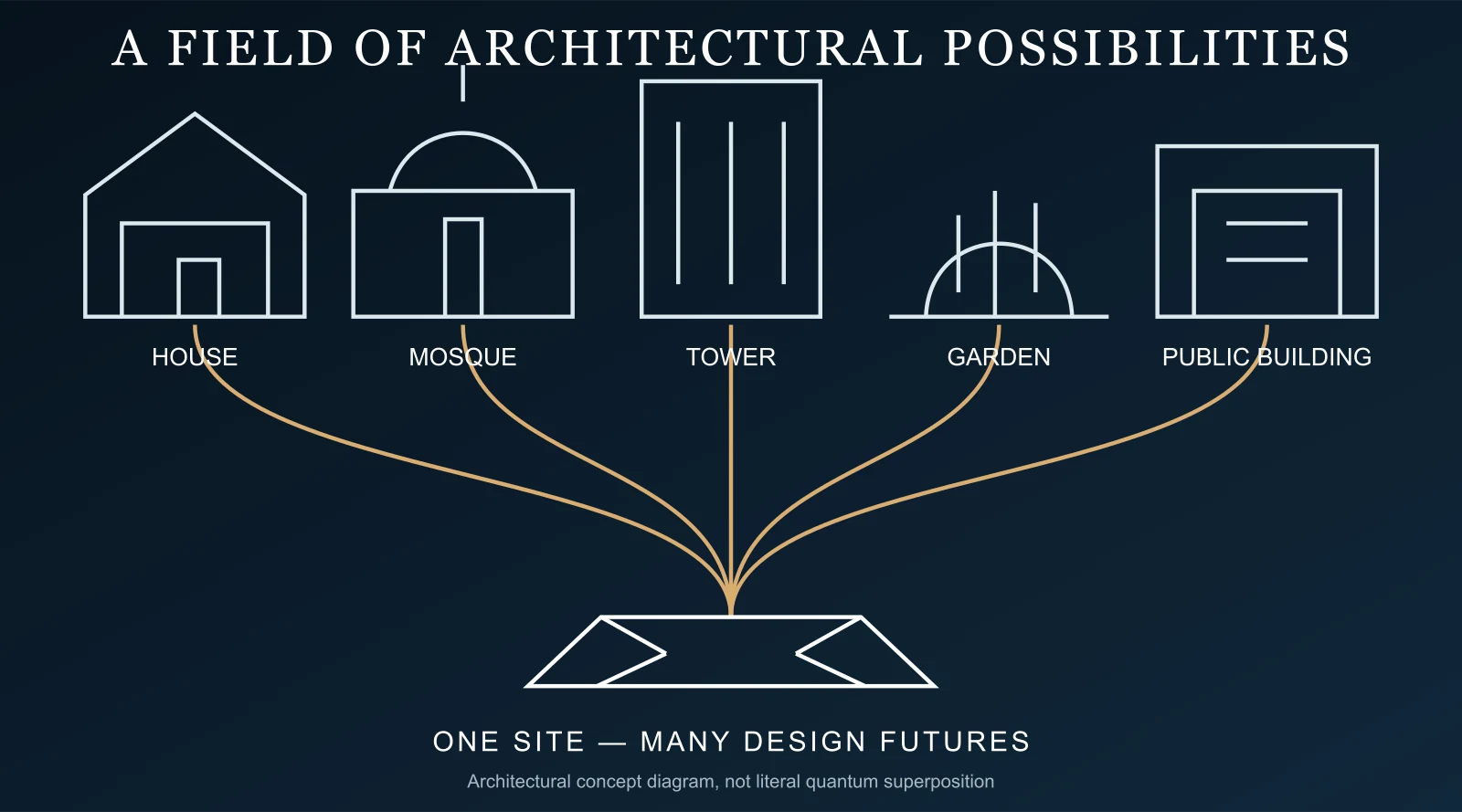
At the beginning of a project, one site contains enormous potential. It might become a house, mosque, hotel, tower, school, garden, commercial complex, public space, or remain vacant. Within each category lie thousands of arrangements of mass and void, entrance and threshold, shade and exposure, privacy and encounter.
I think of this as a field of architectural possibilities.
The architect does not confront an infinite freedom. Possibility is progressively narrowed by site, climate, programme, culture, economics, regulation, structure, material, geometry, client decisions and human experience. Each serious decision excludes alternatives while giving coherence to what remains. A building takes shape through selection as much as invention.
A north-facing opening changes daylight, heat and view. A structural grid invites some room proportions and resists others. A budget closes one material path and may reveal a better one. The design becomes increasingly specific until one possibility becomes drawings, one set of drawings guides construction, and construction becomes matter.
Quantum Possibility
Quantum mechanics describes physical systems at very small scales using a mathematical framework that can represent combinations of possible measurement outcomes. It is among the most successful scientific theories ever developed, and also among the most difficult to translate into ordinary language.
A vacant architectural site is not literally a quantum wavefunction. A proposed house, mosque and tower are not macroscopic buildings waiting in physical superposition for a client meeting to collapse them. Design decisions are not quantum measurements. To say otherwise would turn a useful comparison into bad science.
Quantum theory nevertheless offers architecture an intellectually useful metaphor: before a decision is made, several outcomes may remain genuinely open within the design process. As constraints and choices accumulate, the project becomes more defined. The metaphor is valuable not because buildings obey special quantum rules, but because it trains our attention on possibility, selection and the difference between description and material presence.
The boundary must remain visible. Quantum possibility belongs to established mathematical physics. Architectural possibility belongs to design, culture, economics and human choice. The resemblance is philosophical, not literal.
Many Worlds and the Unbuilt Buildings
In 1957, Hugh Everett proposed a relative-state formulation of quantum mechanics without a collapse postulate. Later developments produced the family of views commonly called the Many-Worlds interpretation. In simplified terms, these interpretations understand different outcomes as realised in different branches of the universal quantum state.
Many-Worlds is an interpretation of quantum mechanics, not experimental proof that parallel architectural universes exist. Its ontology, probability and account of branching remain subjects of philosophical and scientific argument.
Still, it permits a disciplined thought experiment. If reality contained branching histories, one branch might leave the plot vacant; another might contain a house; another a tower; another a radically different design by the same architect.
This suggests what I call the archive of unbuilt worlds.
Architects already know such an archive without invoking a literal multiverse. Every project produces rejected sketches, abandoned plans, alternate façades, lost competitions, value-engineered details and schemes that a client loved but could not afford. These proposals do not become physical worlds, yet they influence the project that does. The chosen building carries traces of alternatives it displaced.
An architect therefore works not only with a final object, but with a disciplined ecology of unrealised possibilities.
Quantum Entanglement: Fact and Metaphor
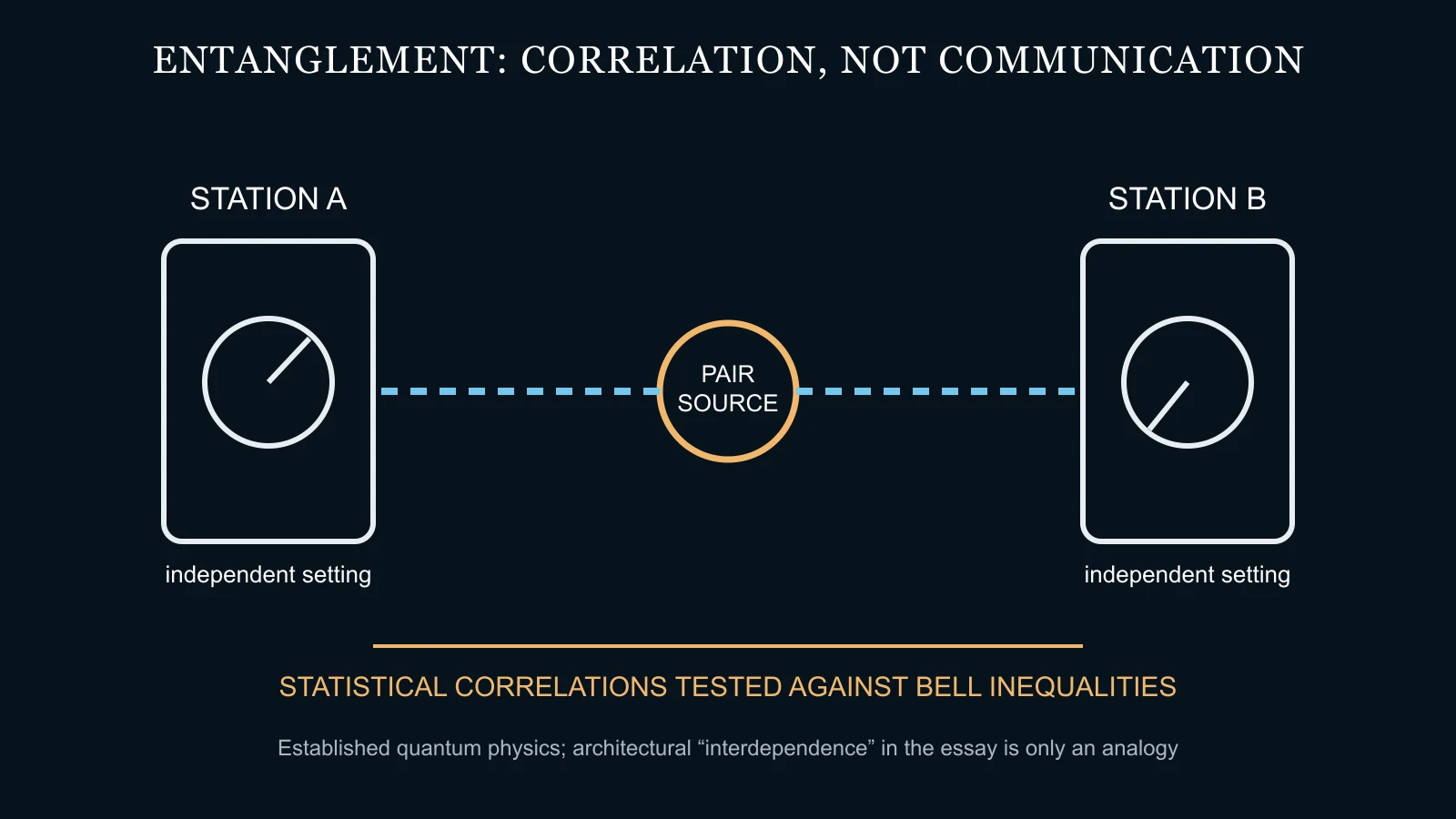
Quantum entanglement is established physics. Entangled systems display correlations that cannot be reproduced by certain local hidden-variable theories. Bell’s inequalities made the distinction experimentally testable, and experiments by John Clauser, Alain Aspect and Anton Zeilinger—recognised by the 2022 Nobel Prize in Physics—helped establish violations of Bell inequalities and opened the field of quantum information science.
This does not mean buildings can become quantum-entangled, that consciousness entangles architecture, or that geometric patterns permit communication between parallel universes. Those claims are unsupported.
There is, however, a clearly labelled architectural analogy. Architecture is relational. Change orientation and daylight and energy change. Change structure and space changes. Change circulation and patterns of movement change. Change the façade and thermal performance, maintenance and public perception change. Change the landscape and microclimate, drainage and experience change.
Nothing in architecture exists entirely by itself.
I call this architectural interdependence, not quantum entanglement. The distinction matters because metaphor should sharpen thought, not borrow scientific authority it has not earned.
Seven Heavens, Seven Earths and the Limits of the Observable
اللَّهُ الَّذِي خَلَقَ سَبْعَ سَمَاوَاتٍ وَمِنَ الْأَرْضِ مِثْلَهُنَّ
“Allah is the One Who created seven heavens, and likewise of the earth…” — Surah At-Talaq, Qur’an 65:12.
The verse does not provide a modern cosmological model, nor should a seventh-century revelation be forced into contemporary scientific terminology. “Seven heavens” does not mean “seven quantum universes,” and the Qur’an should not be recruited as advance certification of whichever theory currently captures public imagination.
Classical tafsir approached the verse through the language, transmitted reports and cosmological understanding available to its scholars. Ibn Kathir discusses seven heavens and likewise seven earths as created realms, while also transmitting reports around their character. That is theological exegesis, not a forecast of quantum mechanics.
Yet the verse confronts the believer with a creation greater than the immediately visible world. Its resonance lies not in a technical equivalence but in intellectual humility. Revelation refuses to make ordinary human perception the measure of all existence. Contemporary physics, through an entirely different method, has also taught us that reality can resist the intuitions formed at human scale.
The theological reflection and the scientific account should remain distinct. Their meeting point is wonder disciplined by limits.

Sacred Geometry: A Language of the Finite and Infinite
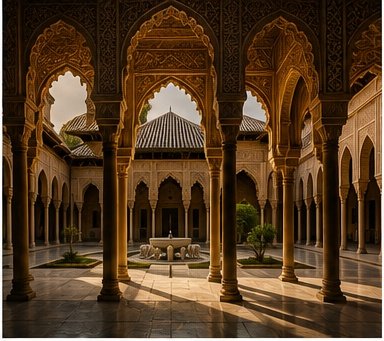
Islamic architecture developed extraordinarily sophisticated languages of symmetry, tessellation, repetition, proportion and geometric transformation. At the Alhambra, geometric tile, carved stucco, water, calligraphy and light complicate the boundary between surface and space. In the mosques of Isfahan, tile fields and muqarnas organise complex transitions through repeated geometries. Girih networks and perforated screens extend a small set of rules into patterns that seem able to continue beyond the edge.
Islamic craftsmen did not need to know quantum mechanics to achieve this. Their work belongs to histories of mathematics, craft, patronage, devotion and architectural practice. The Metropolitan Museum of Art describes repetition, symmetry, proportion and the illusion of infinity as recurring qualities of Islamic geometric design.
Why has sacred architecture across civilisations so often used geometry to represent realities beyond ordinary perception? Perhaps because geometry allows the finite and infinite to meet without pretending they are the same. A wall remains measurable and bounded; the pattern upon it implies continuation beyond what the wall can hold.
Geometry becomes a language through which matter acknowledges what matter cannot contain.
Were Sacred Geometries Portals?
The provocative question should be faced directly. Could ancient sacred geometry preserve forgotten knowledge of passages through space, time or other universes?
There is no established scientific evidence that Islamic patterns, pyramids, mandalas, labyrinths or other sacred geometric constructions functioned as physical portals into other universes or through spacetime. Architecture gains nothing when mystery is inflated into a claim without evidence.
What if the portal was never physical?
A mihrab terminates physically in a wall yet directs consciousness beyond the wall, toward the qibla and the act of prayer. A dome is a finite structural enclosure that can turn perception toward the celestial. A courtyard defines a terrestrial room while opening it directly to the sky. A geometric pattern occupies a finite surface while implying mathematical continuation. Light is physically measurable, yet architecture can use it to make stone appear weightless and dissolve the apparent solidity of matter.
Sacred architecture may not transport the body between universes. It can, however, transform the observer’s experience of reality. That is not a lesser achievement. It is one of architecture’s deepest powers.
The Architect as Observer
Standing before a vacant site, the architect does not see only what is physically present. He sees mass and void, movement and stillness, sunlight at different hours, structure, material, landscape, future inhabitants and events that have not yet happened.
A dining table is positioned for meals that have never occurred. A window frames a sunrise nobody has yet seen from that room. A corridor anticipates footsteps that may arrive years later. A public square anticipates gatherings whose participants have never met.
The architect does not cause these future events by observing them, and imagination does not guarantee they will occur. The observer in architectural practice is not the quantum observer of popular myth. The architect’s role is more concrete and more accountable: to translate incomplete knowledge into spatial decisions on behalf of future life.
The architect therefore works professionally with the not-yet-real.
Toward a Theory of Quantum Architecture
Quantum Architecture, as proposed in this essay, is a philosophical approach to architecture that understands design as the exploration and materialisation of possible states of place across time.
It is not a new branch of quantum physics. Its name marks an architectural concern with possibility while insisting that scientific fact, interpretation and metaphor remain visible as different categories.
Its first principle is that the site is not empty. Every site contains material conditions, histories, obligations, memories and possible futures. Calling it vacant describes the absence of a building, not the absence of reality.
Second, design operates in possibility. Before construction, many architectures remain available. Good design is not the uncontrolled multiplication of options but the intelligent discovery, testing and reduction of them.
Third, the architect works across time. Drawings made today organise spaces, experiences, maintenance burdens and social events that may exist years later. The architect must therefore think beyond the moment of the image and toward the long life of matter.
Fourth, architecture is relational. Form, structure, climate, light, material, landscape and people cannot be understood independently. A decision acquires meaning through the network of consequences it creates.
Fifth, geometry can connect the finite with the concept of the infinite. Islamic sacred geometry demonstrates how a bounded construction can imply continuation without making an unsupported claim about invisible physics.
Sixth, building is materialisation. Construction converts one selected architectural possibility into physical matter. The realised building does not prove it was destined. It records an accumulation of choices, constraints, labour and responsibility.
Together these principles shift attention from architecture as isolated object toward architecture as a temporal act: a movement from conditions, through possibility and information, into inhabited reality.
Is the Building Already There?
Scientifically, we cannot claim that a future building already physically exists merely because an architect can imagine it. Neither relativity nor quantum mechanics gives an architect permission to convert speculation into fact.
Philosophically, certain views of time allow us to question whether future events are simply “nothing.” Eternalism treats them differently from presentism, and the dispute reminds us that ordinary language may conceal assumptions about existence.
Architecturally, the future building can possess extraordinary informational presence before it possesses material presence. It can exist in imagination, survey data, sketches, models, calculations, contracts and coordinated drawings. It can influence budgets, planning decisions and human expectations years before its first foundation is poured.
Perhaps architects do something more interesting than simply predict the future. They give possible futures enough definition that one of them can become real.
The vacant site may therefore be one of architecture’s greatest illusions. To the ordinary eye it contains nothing. To the architect it may contain an entire field of futures.
The architect’s task is not to claim that he has seen the future. It is to look deeply enough into possibility that a future worth building can be recognised.
Is the building already there?
Editorial note: This essay proposes “Quantum Architecture” as an architectural and philosophical framework. References to quantum mechanics, the multiverse and entanglement distinguish established scientific results from interpretations and metaphor. No claim is made that architectural design operates through literal quantum effects at the scale of buildings.
Further Reading & Sources
- The Nobel Prize in Physics 2022 — official press release and scientific background on entanglement and Bell inequalities.
- “Time,” Stanford Encyclopedia of Philosophy — relativity of simultaneity and competing philosophies of time.
- “Being and Becoming in Modern Physics,” Stanford Encyclopedia of Philosophy — philosophical implications of relativistic spacetime.
- “Many-Worlds Interpretation of Quantum Mechanics,” Stanford Encyclopedia of Philosophy — history and interpretation of Everettian quantum mechanics.
- Qur’an 65:12, Surah At-Talaq, with translation; see also the classical tafsir of Ibn Kathir for traditional exegetical discussion.
- “Geometric Patterns in Islamic Art,” The Metropolitan Museum of Art — repeat units, proportion and geometric construction.
- “The Alhambra,” Smarthistory — architectural context for Nasrid geometry, surface and space.
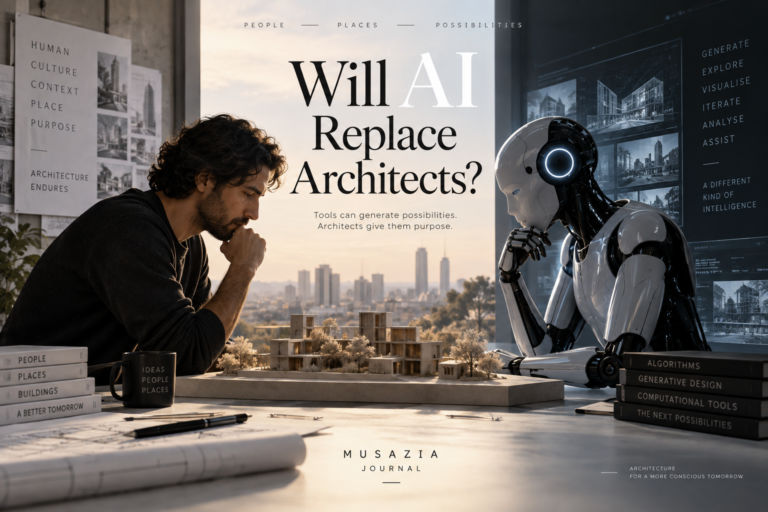
Related in the Musa Zia Journal: Will AI Replace Architects?
Architect Musa Zia
Musa Zia Architects
Islamabad, Pakistan