Why Modern Buildings Are Becoming Forgettable
Architecture has never had more possibilities than it has today.
We can span greater distances, build higher, calculate structures with extraordinary precision and create forms that previous generations could scarcely have imagined. Digital modelling allows us to test buildings before they exist. Glass can cover entire towers. Concrete can assume almost any geometry. Artificial intelligence can now generate hundreds of architectural possibilities in minutes.
Yet despite all this technological freedom, there is a curious paradox in contemporary architecture.
We are producing more buildings than ever before, but fewer buildings seem to remain in our memory.
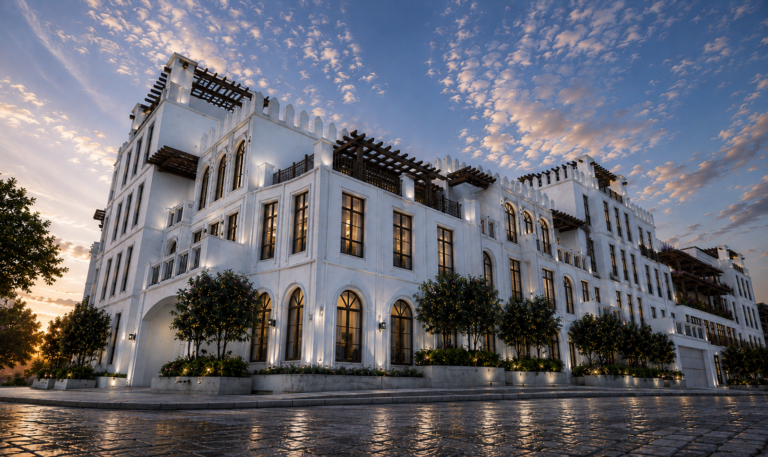
Walk through many newly developed districts around the world and you may encounter impressive towers, immaculate shopping centres, luxury apartment blocks and polished commercial buildings. They may be expensive, technically sophisticated and visually dramatic.
But a few days later, how many can you actually remember?
The question is worth asking:
What makes a building memorable?
And perhaps more importantly, what are we gradually removing from architecture that once allowed buildings to become part of our collective memory?
Architecture Is More Than an Image
One reason may be that contemporary architecture is increasingly designed to be consumed as an image.
A building is rendered before it is built. It appears on a screen, in a presentation, on social media or in a marketing campaign. Consequently, architecture can begin to respond to the logic of photography rather than the deeper experience of inhabiting space.
But architecture is not an image.
A building is approached.
It is entered.
Its walls are touched.
Its shadows move throughout the day.
Its materials age.
Its corridors compress and release.
Its windows frame particular pieces of the world.
Architecture unfolds through time.
Some of the most memorable buildings are not necessarily spectacular in photographs. Their power emerges gradually through movement, proportion, light, texture and sequence.
When architecture is reduced primarily to visual impact, it risks becoming instantly impressive and equally instantly forgettable.
The Disappearance of Identity
Traditional cities were rarely uniform.
Architecture changed from region to region because buildings emerged from different climates, materials, crafts and cultures.
A courtyard house in Lahore did not feel like a house in Istanbul. Architecture in Cairo developed differently from architecture in Venice. Buildings in the mountains responded differently from those in deserts or coastal settlements.
These differences created identity.
Today, the same architectural vocabulary can appear almost anywhere.
Glass curtain walls, aluminium panels, imported stone, composite cladding and standardised construction systems have created enormous freedom, but they have also made architecture increasingly independent of geography.
A building designed for one city can sometimes be transported conceptually to another without substantial change.
When architecture belongs everywhere, it may ultimately belong nowhere.
Buildings Need a Relationship With Place
A memorable building seems to have grown from its surroundings rather than merely landed upon them.
This does not mean architecture must imitate traditional buildings.
Context is deeper than copying arches, roofs or decorative motifs.
It means understanding the forces that make a particular place what it is: climate, topography, vegetation, views, street patterns, culture, materials and human behaviour.
Architecture in Islamabad, for example, can respond to the Margalla Hills, intense summer sun, monsoon rains, vegetation and the relationship between indoor and outdoor life.
Architecture in Muzaffarabad faces another reality altogether. Mountains, river valleys, dramatic topography and changing weather immediately create opportunities for architecture to belong to its landscape.
A building that responds intelligently to such conditions begins to acquire an identity that cannot simply be reproduced elsewhere.
That uniqueness is one of the foundations of memory.
We Remember Proportion More Than Fashion
Architectural fashion changes surprisingly quickly.
Materials become fashionable and disappear. Façade treatments appear everywhere for several years and then suddenly look dated. Certain geometries become popular because software makes them possible.
Proportion behaves differently.
A beautifully proportioned doorway can remain beautiful for centuries.
So can a courtyard.
A colonnade.
A window.
A room.
The great architectural traditions understood that buildings are experienced in relation to the human body. Width, height, rhythm, repetition and scale were not arbitrary decisions.
They created visual order.
When proportion is strong, architecture can remain dignified even after its materials have weathered.
When proportion is weak, expensive finishes rarely rescue it.
This may explain why certain old buildings continue to attract us even after their surfaces have deteriorated. Beneath the ageing material remains an underlying order.
The Loss of Human Scale
Another quality disappearing from many contemporary developments is human scale.
Large buildings naturally require large gestures, but people still encounter architecture at approximately eye level.
We approach a door.
We sit beside a window.
We walk beneath a canopy.
We touch a handrail.
We stand within an arcade.
These moments form our intimate relationship with architecture.
A building may have a spectacular skyline profile while offering almost nothing to the person walking beside it.
Long blank façades, oversized entrances, reflective glass and enormous podiums can create impressive objects while producing uncomfortable environments at street level.
Memorable architecture usually works at several scales simultaneously.
It can contribute to the city from a distance while still rewarding someone standing three feet from its wall.
Material Has Memory
Materials also contribute enormously to architectural identity.
Natural materials record time.
Stone develops patina. Timber changes colour. Brick carries slight variations created during firing. Concrete retains evidence of formwork and construction.
Such materials contain imperfections, and those imperfections often give architecture character.
Contemporary construction increasingly favours surfaces that appear perfectly uniform.
There is nothing inherently wrong with this. Precision can be beautiful.
But when every surface becomes smooth, seamless and replaceable, buildings can begin to lose tactile identity.
There is a difference between a material that merely covers a building and one that participates in its architecture.
Good architecture allows us to understand, consciously or unconsciously, how something is made.
Ornament Was Never Merely Decoration
Modernism correctly challenged meaningless decoration, but somewhere along the way we sometimes began treating all ornament as unnecessary.
Historically, ornament often performed a much deeper role.
In Islamic architecture, geometric patterns created relationships between mathematics, craftsmanship, light and spiritual contemplation.
In classical architecture, mouldings and profiles articulated transitions between structural elements.
Traditional screens moderated sunlight while simultaneously creating extraordinary patterns of shadow.
Craft gave human presence to buildings.
The question therefore should not be whether contemporary architecture requires ornament.
The better question is:
Does every architectural element have meaning?
A building can be completely minimal and still possess enormous richness if its proportions, joints, materials, shadows and details have been carefully considered.
Simplicity and emptiness are not the same thing.
Architecture Needs Moments of Discovery
Memorable buildings rarely reveal everything immediately.
They contain sequence.
A narrow entrance may lead into a generous courtyard.
A dark passage may suddenly reveal sunlight.
A framed opening may capture a distant landscape.
A staircase may gradually disclose a space above.
These transitions create architectural memory because the building becomes an experience rather than simply an object.
Traditional Islamic architecture understood this particularly well.
Many mosques, houses, gardens and palaces were composed as sequences of thresholds, courtyards, arcades, water, shade and light.
The architecture was discovered gradually.
Perhaps contemporary buildings sometimes become forgettable because they reveal themselves too quickly.
We see the façade and immediately understand the entire idea.
There is nothing left to discover.
Technology Is Not the Enemy
It would be easy to blame technology for the shortcomings of contemporary architecture.
That would be a mistake.
Technology is an extraordinary tool.
Digital design, advanced engineering, environmental simulation and artificial intelligence can expand architectural possibilities enormously.
The danger begins only when tools start determining architecture rather than serving it.
A building should not exist simply because software can generate its geometry.
Nor should complexity automatically be confused with creativity.
The fundamental architectural questions remain remarkably old:
Where is the sun?
Where does the wind come from?
How does a person approach the building?
What should they see when they enter?
How does the structure meet the ground?
What is the relationship between inside and outside?
What will this material look like twenty years from now?
These questions cannot become obsolete.
Designing Buildings That People Remember
Perhaps memorable architecture does not begin with the ambition to create an icon.
It begins with attention.
Attention to place.
Attention to proportion.
Attention to material.
Attention to climate.
Attention to movement.
And above all, attention to human experience.
A building becomes meaningful when these individual decisions begin supporting one another.
Then architecture acquires coherence.
And coherence gives a building identity.
The architecture we remember most deeply is rarely remembered because of a single façade or dramatic gesture. We remember how sunlight entered a room, how a courtyard felt in summer, how stone sounded beneath our footsteps, how a window framed a mountain or how a building seemed inseparable from the place in which we encountered it.
Architecture becomes memorable when it gives us something more than an image.
It gives us an experience.
And perhaps that should remain one of architecture’s greatest ambitions: not simply to be noticed when it is completed, but to remain in the human memory long after we have left it.