The Alhambra: When Mathematics Became Poetry
There are buildings that impress us through size. Others through engineering, wealth or monumentality.
And then there are buildings whose power is more difficult to explain.
The Alhambra is one of them.
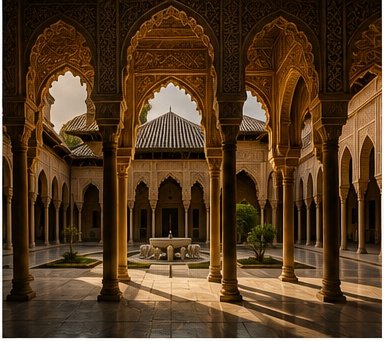
Perched above Granada in southern Spain, with the Sierra Nevada forming its distant backdrop, the Alhambra does not depend upon monumental scale to establish its presence. Much of it is surprisingly intimate: courtyards, chambers, arcades, gardens, narrow passages and quiet pools of water.
Yet within these spaces exists one of the most sophisticated architectural worlds ever created.
Geometry covers walls without making them heavy. Calligraphy becomes architecture. Water becomes a mirror. Light transforms solid surfaces into changing patterns of shadow. Small openings frame distant landscapes with extraordinary precision.
Everything seems ordered, yet nothing feels mechanical.
Perhaps this is the real mystery of the Alhambra:
How did an architecture governed so deeply by mathematics become so poetic?
Architecture That Does Not Reveal Itself at Once
One of the first lessons of the Alhambra is that architecture does not need to announce everything immediately.
It can unfold.
You pass through a relatively restrained entrance and discover a courtyard. You move through shadow and suddenly encounter intense Andalusian sunlight. A narrow passage opens into a larger chamber. An arch frames another arch, and beyond it appears water, vegetation or the distant city.
The building constantly controls what is concealed and what is revealed.
This creates anticipation.
And anticipation creates memory.
Much contemporary architecture is designed to be understood almost instantly. We see the façade, recognise the architectural gesture and understand the building’s visual idea.
The Alhambra works differently.
It asks you to move.
Architecture becomes a sequence rather than an object.
Perhaps that is why photographs, however beautiful, never completely explain it.
Geometry Beneath the Beauty
At first glance, the ornament of the Alhambra may appear overwhelmingly complex.
Look longer and another reality emerges.
Beneath that complexity is discipline.
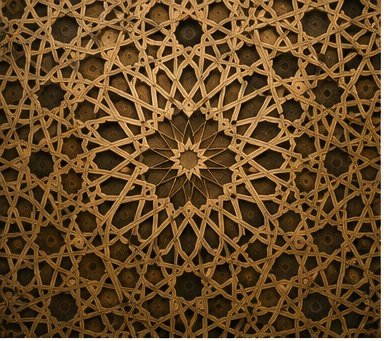
Circles generate relationships. Squares rotate. Polygons intersect. Stars emerge. Lines continue into neighbouring shapes. Small geometric units repeat until they become fields of extraordinary intricacy.
The beauty is not accidental.
It grows from order.
This principle lies at the heart of Islamic geometric design. Complexity does not necessarily require arbitrary form. A relatively limited set of geometric relationships can generate an astonishing variety of patterns.
This is an architectural idea as much as a decorative one.
The designer establishes a system.
Then the system produces richness.
There is something remarkably contemporary about this thinking. Today we speak about parametric systems, generative design and rule-based geometry as though architecture has only recently discovered them.
Yet centuries ago, Islamic craftsmen and architects were already exploring how simple geometric rules could generate complex visual worlds.
They simply did it with a compass, straightedge, mathematics and extraordinary craftsmanship.
The Infinite Inside the Finite
There is another quality within Islamic geometry that fascinates me.
The pattern rarely seems to end.
A geometric composition reaches the boundary of a wall, yet visually we understand that it could continue beyond that boundary.
The wall is finite.
The geometry suggests infinity.
This relationship between the finite and infinite gives Islamic geometric art much of its contemplative power.
The eye follows one line. It meets another. A polygon becomes part of a star. The star becomes part of a larger pattern. The larger pattern dissolves again into smaller relationships.
Where does it begin?
Where does it end?
Eventually those questions become almost irrelevant.
You begin to perceive not individual shapes but an underlying order.
For me, this is where geometry begins to move beyond decoration.
It becomes philosophical.
The visible pattern hints at an order larger than the portion we are capable of seeing.
Perfection Without Monotony
Pure mathematics can sound cold.
Architecture cannot afford to be.
Human beings do not inhabit equations. We inhabit spaces filled with changing light, sound, texture, temperature, movement and memory.
The genius of the Alhambra is that mathematical order never suppresses these human experiences.
It supports them.
Geometry establishes discipline, but craftsmanship introduces variation.
Repetition creates rhythm, but light constantly changes the composition.
Symmetry provides stability, while water introduces movement.
Order and imperfection coexist.
This is important.
The objective of architectural order is not to remove life from a building. It is to create a framework within which life can become richer.
When Light Becomes a Building Material
The Alhambra cannot really be understood by studying its plans and elevations alone.
Something essential would be missing.
Light.
Andalusian sunlight is powerful. Rather than simply allowing it to enter, the architecture filters, frames and manipulates it.
Deep openings produce shadow.
Arcades create transitions between brightness and darkness.
Carved plaster catches light across thousands of tiny surfaces.
Muqarnas break ceilings into complex geometries so that illumination appears fragmented and almost weightless.
Perforations and openings allow controlled shafts of light to enter interior spaces.
The result changes continuously.
The architecture you encounter in the morning is not quite the architecture you encounter in the afternoon.
This reminds us of a fundamental principle:
Architecture is not made only from things we can touch.
Light is also a material.
So is shadow.
A wall becomes meaningful partly because of the light falling upon it.
An opening becomes meaningful because of what it reveals.
And a ceiling can appear heavier or almost weightless depending upon how illumination meets its surface.
Water as Architecture
Then there is water.
At the Alhambra, water is never merely landscaping.
It organises space.
It reflects architecture.
It produces sound.
It cools the air.
It creates movement within otherwise static compositions.
The long pool of the Court of the Myrtles demonstrates this beautifully.
The surrounding architecture appears once in stone and plaster, and then again in reflection.
One is solid.
The other trembles.
A perfectly symmetrical building becomes distorted by the smallest movement of water.
Architecture suddenly acquires another dimension.
The physical building is finite, but its reflection extends it visually into another world.
Elsewhere, narrow water channels pass quietly through gardens and courtyards. Fountains introduce sound into spaces that might otherwise be silent.
What is particularly remarkable is that beauty and environmental performance are not separated.
Water is practical and poetic simultaneously.
That is sophisticated design.
The Courtyard and the Sky
One of the most powerful elements of Islamic architecture is also one of the simplest.
An empty space.
The courtyard.
Instead of treating the building as an isolated object surrounded by leftover landscape, the courtyard brings landscape, air, water and sky into the architecture itself.
Rooms turn inward.
Arcades create shade.
Vegetation softens surfaces.
Water modifies temperature.
And above everything is a carefully framed piece of sky.
The courtyard is therefore neither completely inside nor completely outside.
It occupies an architectural threshold between the two.
This ambiguity gives it extraordinary richness.
In contemporary architecture we often spend enormous resources controlling interior environments mechanically. Yet the courtyard reminds us that architectural form itself can participate in environmental comfort.
It is not merely historical nostalgia.
It is climatic intelligence.
When Walls Begin to Speak
Geometry is only one layer of the Alhambra.
Another is language.
Arabic calligraphy flows across walls, columns, borders and architectural surfaces. Poetry, inscriptions and devotional expressions become inseparable from the spaces they inhabit.
This creates something extraordinary.
The building can literally be read.
Architecture communicates through proportion and geometry, but also through words.
A surface may simultaneously contain mathematical order, craftsmanship, language and symbolism.
Imagine the intellectual richness of such a wall.
It is not simply cladding.
It is architecture carrying meaning.
This is something contemporary practice might reflect upon. We have become extremely sophisticated at producing surfaces, yet not every surface has something to say.
Ornament Is Not the Opposite of Modernity
Modern architecture taught us an important lesson: decoration without purpose can become superficial.
But the lesson is sometimes taken too far.
We begin to assume that ornament itself is somehow intellectually inferior to abstraction or minimalism.
The Alhambra challenges this assumption.
Its ornament is not something applied after architecture has been completed.
Geometry reinforces proportion.
Calligraphy establishes borders and hierarchy.
Carving responds to light.
Pattern changes our perception of scale.
Muqarnas negotiate transitions between architectural forms.
Ornament participates in architecture.
That distinction matters.
The real question is therefore not whether a contemporary building should have ornament.
The question is whether its details have meaning.
Minimalism can be profound.
Ornament can be profound.
Both can also be empty.
An Ancient Architecture With Contemporary Lessons
Perhaps one reason the Alhambra remains relevant is that many ideas contemporary architecture is rediscovering were already embedded within its design.
Shaded transitional spaces.
Courtyard planning.
Passive cooling.
Controlled daylight.
Water integrated with microclimate.
Connection between architecture and landscape.
Local craftsmanship.
Human scale.
Geometric systems.
Layered façades.
Indoor-outdoor relationships.
None of these requires us to reproduce historical Islamic architecture.
That would be the wrong lesson.
We do not need to copy its arches.
We need to understand why the arches were there.
We do not need to reproduce its ornament.
We need to understand the order behind it.
We do not need to imitate its courtyards.
We need to understand what the courtyard accomplished environmentally, socially and spatially.
Tradition becomes useful when we understand its intelligence rather than merely its appearance.
Architecture Between Reason and Emotion
As an architect, what fascinates me most about the Alhambra is not any single pattern or courtyard.
It is the coherence between everything.
Geometry relates to ornament.
Ornament interacts with light.
Light reveals material.
Architecture frames landscape.
Landscape incorporates water.
Water reflects architecture.
Calligraphy gives surfaces intellectual and spiritual meaning.
And the human being moves through all of these layers.
Nothing seems completely isolated.
This is perhaps one of the deepest lessons architecture can offer.
A great building is not necessarily created by one spectacular idea.
It emerges when many decisions begin supporting the same idea.
Structure, proportion, material, light, landscape, climate and human experience begin speaking to one another.
Then architecture develops coherence.
And coherence is often what we experience as beauty.
When Mathematics Becomes Poetry
The Alhambra demonstrates something that architecture should never forget.
Reason and emotion are not enemies.
Mathematics does not have to produce coldness.
Order does not have to eliminate mystery.
Geometry does not have to suppress imagination.
A circle drawn with a compass is rational.
A pattern generated from that circle can appear infinite.
A courtyard is a simple geometric void.
Fill it with water, shadow, vegetation, changing sunlight and human life, and it becomes something entirely different.
Architecture begins with measurable things: dimensions, angles, structure, proportion and material.
But great architecture eventually produces something that cannot be measured so easily.
Wonder.
Memory.
Stillness.
Belonging.
Perhaps even contemplation.
That is what makes the Alhambra extraordinary.
Its mathematics can be analysed.
Its geometry can be reconstructed.
Its proportions can be measured.
But after all the analysis is finished, something remains.
And in that remaining space between reason and experience, mathematics becomes poetry.